
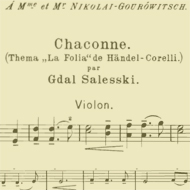
Dedicated to Mme et Mr Nikolai-Gourówitsch
 |
The sheet music, 2 parts, 34 cm |
-
- Published by Kristiania : Oluf Bys in the year 1920
- Two parts 34 cm
- Part of the public domain collection made available by the University of Rochester at: http://hdl.handle.net/1802/14119
|
The sheet music typeset by Alonso del Arte |
We don't know why the variations were written, but Salieri, who enjoyed a reputation as being among the more innovative composers, had evidently kept pace with 19th-century trends in orchestral writing: the complete work makes striking use of brass and woodwind colors, and even includes solos for the harp as well as the violin. [In these performances we perform a selection of variations highlighting the virtuosity and colors of our strings and woodwinds.] Salieri rarely strays from the folia theme, the variety is to be found in the brilliant way he exploits different instruments or combinations in turn, a literal anthology of symphonic possibilities. No wonder it has been compared to Ravel's Bolero. But intriguing as it is, Salieri's 'La folia' has no more been able to claim a place in posterity than its composer.
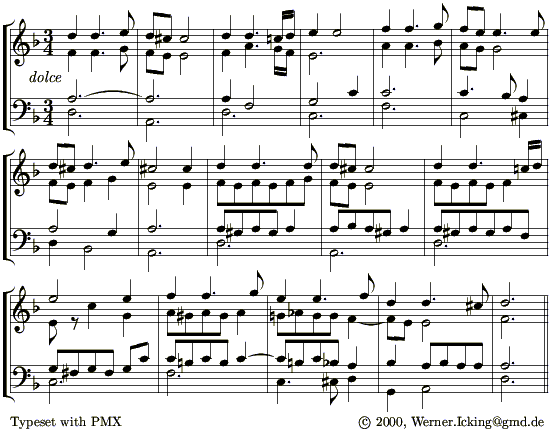
| Opening of Variazoni sull'aria La Follia di Spagna | |
|---|---|
 |
|
- Craton, John (arrangement for violin and piano)
- Title: 26 Variazioni sulla Follia di Spagna
- Published 2004 by Wolfhead Music http://www.wolfheadmusic.com/salieri.htm
- Pages: 34 pp. (piano pt.), 11 pp. (violin pt.), 8½” x 11”
- London Mozart Players/Bamert, Matthias 'Antonio Salieri Symphonies,
Overtures & Variations'
 Steven J. Haller wrote for the 'American record guide' in the issue May
2001 (and he obviously fails to hear any beauty in the Folia theme):
Steven J. Haller wrote for the 'American record guide' in the issue May
2001 (and he obviously fails to hear any beauty in the Folia theme):
Main course here, as in so many recent Salieri repasts, is the La Folia Variations. The interminable and not very imaginative shifts from winds to strings (or fast to slow) and back again that here suffice for "variations" make this one of Salieri's less impressive efforts, particularly set next to the overtures. Pesko takes about 20 minutes for the variations, while Frontalini takes 21 and Spada on ASV takes 23 (Sept/Oct 1996). Bamert without ever sounding rushed or superficial gets through it in 17:47, and (even better) actually manages to hold your interest while doing so. The others have their virtues too, but I think you'll be quite happy with Bamert, assuming you ever want to listen to the piece to begin with.
- Title: Twenty-six Variations on 'La folia di Spagna'
- Released 2001 by Chandos compact disc CH CHAN 9877
- Duration: 17'47"
- Recording date: 2001
- London Symphony Orchestra/Peskó, Zoltán with Richard Studt (violin) and Renata Schefel-Stein (harp) 'Salieri, La Follia'
- Title: 26 Variazioni sull'aria "La follia di Spagna"
- Released by Warner Fonit compact disc 50467121720
- Duration: unknown
- London Symphony Orchestra/Peskó, Zoltán 'Symfonia Veneziana
da la scuola de gelosi' revisioni di Pietro Spada
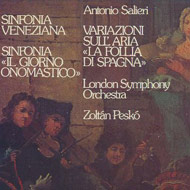
- Revisioni di Pietro Spada
- Title: XXVI Variazioni sull'aria "La follia di Spagna" (1815)
- Released 1978 LP Italia ITL 70052
- Duration: 19'10"
- London Symphony Orchestra/Peskó, Zoltán 'Symfonia Veneziana,
Variazioni Sull'Aria 'La Follia di Spagna'
 Pietro Spada (Engish version by Carole McGrath Manzoni) wrote as an introduction:
The 'Variations on the Follia of Spain' are in all probability Salieri's last symphonic work and can be chronologically placed in the middle of the Beethoven period (1815). They are almost surely the only nineteenth-century orchestral variations until Brahms's celebrated 'Variations on a theme by Haydn'. The folk song, incorrectly called 'Follies d'Espagne', which provides the theme is of seventeenth century Portuguese origin, and has been used and made famous by many composers including Corelli, d'Anglebert, Scarlatti, Pasquini, Bach (in his Cantatas), Cherubini (in the 'Osteria Portoghese'), Liszt (in his 'Spanish Rhapsody'), and Rachmaninov (in his 'Variations on a Theme by Corelli' op. 45).
It is hard for us to imagine why an elderly Salieri decided to compose a piece of this type - the work itself is conceived a bit in the spirit of a study in orchestration (as the later, famous Ravel's 'Bolero'). The instrumental draft faithfully follows the theme, always based on compositional and orchestral schemes which give the piece somewhat the air of an anthology of symphonic permutations relieved with solistic interludes. We can also discover canons and classic imitations as, for example, the dance movements in the pleasing variation in the 'Siciliana' style. This may not be a work of deep expression, but it shapes itself and finds the exact definition of its limits as an intellectual 'divertissement'.
Above all, and this is what makes it especially noteworthy, it manages to completely transcend that eighteenth-century climate which had dominated a great part of Salieri's previous works- Revisioni di Pietro Spada
- Released 1982 by CBS Masterworks (licensed exclusively to CBS by Fonit-Cetra, Milan) LP 74088 CB321
- Duration: 19'10"
- Moldavian National Symphony Orchestra/Frontalini, Silvano 'Ouvertures'
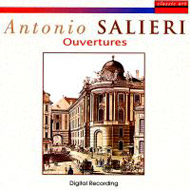
Duration: 21'25" direct link to YouTube
The complete Variazioni by the Moldavian National Symphony Orchestra
© 1998 by Blue Moon Productions - Azzurra- Variazioni sulla Follia di Spagna
- Released 1998 by Tring S.r.l. compact disc CAD 006 and 2002 Blue Moon Productions - Azzurra
- Duration: 21'25"
- Recording date: 1997
- Philharmonia Orchestra/Spada, Pietro 'XXVI Variazoni sull'aria "La
Follia"
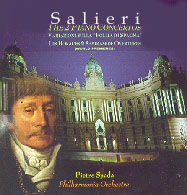 Pietro Spada wrote about Salieri's variations in the slipcase:
This was the last work by the senescent composer. A sort of brooding soliloquy but, at the same time, something of a massive study in timbre and instrumentation, much as Ravel's Bolero was to be in the 20th century. It certainly set Salieri's musical fancy ranging, from symphonic declamation to virtuoso canon, from the melancholy pace of the Siciliana to the dark, muffled timbre of a trio of solo trombones, somewhat reminiscent of Mozart's Connitato di pietra. In conclusion we have what practically amounts to an anthology of situations and instrumental colouring
- Released 1996 by ASV digital compact disc CD DCA 955
- Duration: 22'17" and every variation indexed (22)
- Sinfonia Varsovia conducted by Peter Csaba 'Die Variationen über "La follia di Spagna"
Only half of all the variations were played during the performance.- Recorded live at the Festival "La Folle Journée" January 29, 2005 in Nantes
- Broadcasted by Euroclassic Notturno October 2005 (Netherlands, Radio 4 during the night)
- Duration: 12'33"
- Spada, Pietro editor of the music
- Title: XXVI Variazoni sull'aria La Follia di Spagna a cura di Pietro Spada
- Published 1978 by Boccaccini & Spada Editori s.r.l., Roma
- WDR Sinfonieorchester Köln/Goebel, Reinhard and Elise Batnes violin
Eckhard Weber wrote for the program of the concert:Wie ein Straßenkind Karriere machen kann, zeigt der Werdegang des Volkstanzes Folia. Eine spanische Quelle aus dem frühen 12. Jahrhundert schildert ihn folgendermaßen: "Es handelt sich um einen bestimmten lärmenden portugiesischen Tanz, an dem viele Personen mit sonajas (`Schellentrommeln`) und anderen Instrumenten teilnehmen, außerdem einige maskierte Rüpel, die auf ihren Schultern als Mädchen verkleidete Jungen tragen. Sie bilden mit ausgestreckten Armen manchmal einen Kreis oder tanzen und spielen die Schellentrommeln; der Lärm ist so groß und die Musik so schnell, daß alle von Sinnen zu sein scheinen." Auch über die Bedeutung des Namesns gibt die Quelle Auskunft: "... der Tanz erhielt den Namen "folia" nach dem toskanischen Wort "folle", das eitel, verrückt, von Sinnen bedeutet bzw. jemanden bezeichnet, der einen leeren Kopf hat".
Dieser ausgelassene Tanz war so populär, dass er bereits um 1500 an den portugiesischen Königshof kam. Auch eine eigene Mode gab es für den Tanz, die bald als "vestiti alla Pourtughesi" ("portugiesisch gekleidet") bezeichnet wurde. Gleichzeitig fand unter dem Namen Folia eine harmonisch-melodische Formel, ein ostinates Bassmodell, wie dies etwas auch die Passacaglia oder letztendlich auch das Blues-Schema darstellen, Eingang in die Kunstmusik. Vor allem vom 16. bis 18. Jahrhundert erfreute sich die Folia in dieser Form zunächst in Spanien, dann europaweit großer Beliebtheit und bot die Grundlage für Lieder, Tanzsätze und Instrumentalvariationen in verschiedensten Besetzungen. Vor allem für die Gitarre und ihre Voläufer, Laute und spanische "vihuela", wurde die Folia gerne herangezogen. Alle wichtigen Gitarristen hatten im 17. Jahrhundert Folia-Stücke im Repertoire. Vermutlich mit dem gefeierten italiensichen Gitarristen Francesco Corbetta gelangte die Folia Mitte des 17. Jahrunderts nach Frankreich an den Hof des Sonnenkönigs Ludwig XIV. Hier kam die Bezeichnung "Les folies d`Espagne" auf. Spanien statt Porutgal wurde fortan als Ursprungsland gesehen. Wie in vielen Künsten strahlte der Geschmack des Sonnenkönigs auch im Fall der Folia auf ganz Europa aus: Corelli, Vivaldi, Bach, sie alle schrieben in der Folge Folia-Sätze. Die eingängige Formel bot ein zuverlässiges Gerüst für virtuose Improvisationen und Variationen. Wie bei vielen Barocktänzen, die der Folklore entstammen, verlangsamte sich durch die höhere Kunstfertigkeit in der Melodieführung das Tempo.
1815, gegen Ende seiner Laufbahn, als Antiono Salieri längt europaweite Berühmtheit erlangt hatte als erfolgreicher Opernkomponist, Schöpfer von Sakralmusik, Lehrer sowie als Wiener Hofkapellmeister, setzte auch er sich mit der Folia auseinander. Er nahms das traditionsreiche Modell als Grundlage für einen Variationszyklus, mit dem er die Möglichkeiten des klassichen Orchesters einfallsreich ausreizte. Seine 26 Variationen über "La Folia di Spagna" gerieten zu einer originellen musikalischen Charakterstudie. Das Werk beginnt sehr getragen. Diese Stimmung prägt auch noch die erste Variation in den tiefen Streichern, aber schon die zweite Variation nimmt ernormen Schwung auf. Das Ausgelassene wie auch das Virtuose kommt im weiteren Verlauf zur Geltung. Kusntvolle Solopassagen wechseln sich ab mit Bläserchorälen, Gewittermusik und raffinierten Echoeffekten. Salieri zeigt den gesamten Kosmos der Folia, zeichnet sie pathetisch, ausgelassen, zurückhaltend, graziös, wild, schwungvoll, kapriziös und dramatisch. Das Werk zeigt: Das alles ist die Folia.- 26 Variationen auf "La folia di Spagna"
- Broadcasted by WDR-Radio (Germany) January 20, 2006 and Klara Radio (Belgium) February 18, 2007
- Duration: 17'50"
- Recording date: Recorded by Westdeutsche Rundfunk during a live performance January 20, 2006 in the Funkhaus, Köln, Germany
- WiZARDS! (double reed consort) 'Classical Wizards'
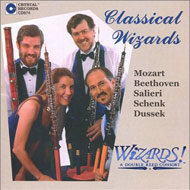 Mark Weiger wrote about Salieri's variations in the slipcase:
Salieri's subsequent few compositions were mostly of a more entertaining genre (divertimenti, etc.) In fact, his Variazioni sulla Follia di Spagna of 1815 is in all probability his last symphonic work. [...]
While Salieri did write works featuring double reed instruments (Drei Trios for 2 oboes and bassooon; Picciola Serenata for 2 oboes, 2 horns, and bassoon; Cassazione for 2 oboes, 2 English horns, 2 bassoons, and 2 horns da caccia), Variazioni sulla Follia di Spagna is a set of 24 variations originally scored for orchestra. It has been deftly transcribed for a double reed sextet of 2 oboes, 2 English horns, and 2 bassoons by Jeffrey Linville as a special project for the University of Iowa's Double reed Ensemble. It has been prepared for publication through Bocal Music. The theme and variations that were used are as follows: Tema: Andante, Var. 1 Andante, Var. 2 Piu Mosso (originally #3), Var. 3 Allegro (originally #5), Var. 4 Allegretto (originally #7), Var 5 Poco Adagio (originally #8), Var. 6 Allegretto (originally #11), Var. 7 Poco piu Allegro (originally #12), Var. 8 Allegro (originally #16), Var. 9 Larghetto (originally #18), Var. 10 Allegretto (originally #20), Var. 11 Allegretto (originally #21), Var. 12 Andante Pastorale (originally #23), Var. 14 Presto (originally #24), var. 15 Allegro moderato-Adagio-Allegro.
The term Follia, which appears as early as the 15th century in Portuguese and Spanish poetic texts, dances, and song variations (usually accompanied by guitar), is of two styles: the "early follia" and the "late follia". Salieri employs the late follia style in this set of variations. The earliest example of the "late follia" is an Air des Hautbois from 1672 by Lully. In the late follia style a specific harmonic structure is maintained throughout a set of variations, almost always in the key of D minor with the second beat of the odd measures being dotted and slightly accented. This is the style which became a very popular form, taken up by the likes of Marin Marais (1701), A. Scarlatti, Liszt, Cherubini, to Rachmaninoff in his Variations on a Theme by Corelli, Op. 45 (1932).- Title: Variazioni sulla Follia di Spagna
- Arranged by Jeffrey Linville for 2 oboes, 2 english horns, and 2 bassoons
- Released 2000 by Crystal Records, compact disc CD 874
- Duration: 10'38"
- Recording date: January 8-10, 1999 at St. John's Lutheran Church in Bloomington, Il, USA.
- Sanchez, Blas
- Published 1969 by Editions Choudens, 38 Rue J. Mermoz, Paris 8, France
- Series 'L'heure de la Guitare Classique'
- Order number AC 20.318
First published in 'Instrucción de música sobre la guitarra española' in three books 1674/5. Again published in 1697. The first edition in 1674 only contained the first book of the three. The five subsequent editions are all dated in 1675 though it is not unlikely that some of them have been published somewhat later, and the other two, which contain all three books unabridged, are from 1697. The Folías appear in book 2. This second book contains 12 pages of music for plucking, with some of the most characteristic dances of the period in Spain.
These books of instructions were written for Don Juan (natural son of Philip IV), who appointed him master of guitar.
In her book Music in Eighteenth Century Spain Mary Neal Hamilton suggests that it was Sanz who gave the melody and structure to the 'later' Folia quoting page 24:
The type (of Folias de Espana) is familiar to musicians through the 'Folias de Espana', used by Corelli as foundation for a set of variations incorporated in a violin sonata, published about 1700. Before Corelli, the 'folias' was known and used in Italy by a certain Cristiano Farinelli, said to have been an uncle of the famous sopranist singer. It was a very populair melody in Italy and was brought from Spain perhaps by Gaspar Sanz himself, the famous Spanish guitarist, who lived for a time in Naples and in Rome. The tune is found in a book of 'Instrucción de música sobre la guitarra española' (Instruction in the music of the Spanish guitar), written and examples collected by Gaspar Sanz and published ten years before the birth of Bach..
And she continues on page 149:For Don Juan he wrote a book of instructions, printed in Saragossa in 1674, which contained a collection of national dances, including the original Folias de España, a tune used in the eighteenth century and to this day by innumerable European composers, beginning with the violinist Corelli.
Donald Sauter published the tablature for guitar of the second book including Folias at http://www.donaldsauter.com/gaspar-sanz.htm

|
Duration: 2'28", 05 kB. |
 |
Duration: 1'28", 03 kB. |
|
Duration: 1'23", 03 kB. |
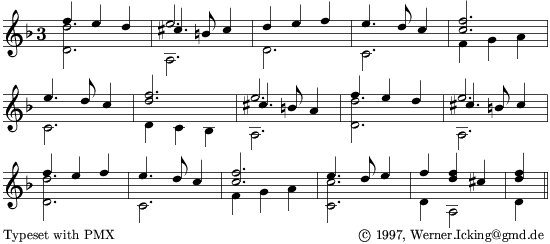
| Theme by Sanz | Arranged for guitar by Karl-Heinz Böttner, Pycrus Edition |
|---|---|
 |
|
- Águeda, Sara (arpa doppia) and Mulder, Juan Carlos de (baroque guitar)
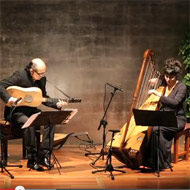
Sara Águeda and Juan Carlos de Mulder play Sanz and Martin Y Coll
Duration: 5'15" direct link to YouTube
© Sara Águeda and Juan Carlos de Mulder- Title: Folías (by Gaspar Sanz and Martín Y Coll)
- Released April 2, 2014 on YouTube by Sara Águeda
- Duration: 5'15"
- Broacasting date: April 2, 2014
- Armoniosi Concerti 'Zarambeques, Música Española de los
Siglos XVII y XVIII en torno a la Guitarra'
In the slipcase is stated:The Folia is a danza of Portuguese origin with an extensive history in Spain - there being references to it as far back as the fifteenth century. During the course of the seventeenth century the harmonic pattern known as the folías de España became widely used (the three that we include here follow that pattern). Gaspar Sanz's lovely Folías are known to all enthusiasts and on this occasion they can be heard being strummed on a guitarilla strung with four and five high-pitched courses - the tuning preferred by the author in order to "puntear con primor, y dulçura" (to pluck with delicacy and sweetness).
- Title: Folías
- Instrumentation: Juan Carlos Rivera (guitarrilla in a, stringed without basses)
- Released 2002 by Harmonia Mundi compact disc HMI 987030
- Duration: 3'42"
- Recording date: May 29 and 30, June 1 and 2, 2002 in Sala de Cámara del Conservatorio Superior de Música de Sevilla, Spain
- More about the oeuvre of Juan Carlos Rivera at http://www.juancarlosrivera.com
- Attademo, Luigi 'Folías; Sanz, Giuliani, Ponce, Gilardino, Sor,
Ohana'
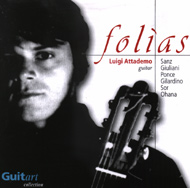
- Released 2001 by the Magazine 'Guitart' compact disc GUIT 2026
- Duration: 2'15"
- You can listen to a fragment in MP3 at the website of Luigi Attademo http://www.luigiattademo.it/
- Recording date: March 25 and 29 2001 at Quality Audio, Vercelli, Italy
- Guitar by Carlo Raspagni, 1996
- See also the page Recommended Folia-recordings
- Axivil Castizo directed by F. Sánchez (with C. Carazo) 'Sarao Barroco'
This is an arrangement of the three Folías by Sanz, Guerau and Santiago de Murcia originally for guitar.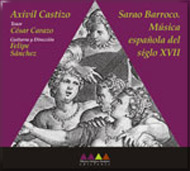
- Title: Folías
- Released 2005 by Harmonia Mundi Espagnol compact disc MAA 003
- Duration: 4'58"
- Recording date: unknown
- Azpiazu, José de edited the music for guitar
- Title: 'Folias - Pavanes'
- Published by Ricordi 1969,
- Score 3 p.
- Publisher No. SY2119
- ISMN M-2042-2119-6
- Barreiro, Elias 'in Guitar Classics'
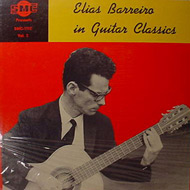
- Title: 'Folias'
- Released mid 1960's by SMC Records LP 1112 MONO
- Duration: 1'17"
- Recording date: unknown
- Arrangement: Pujol
- Benichou, Andre 'Guitare Bach'
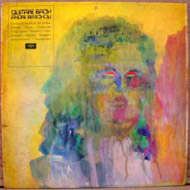
- Title: 'Folias'
- Released 1969 by Vogue LP VRLS3038 (made in England)
- Duration: unknown
- Recording date: unknown
- Böttner, Karl-Heinz edited the music for guitar
- Title: Folias II in: 'Gaspar Sanz, Gallardas con otros dances espanoles (26 Spanische Tänze und Weisen)'
- Published by Pycrus Edition GmbH 1977, Köln
- Score 3 p. (including 1 p. chord progression) 21 x 29 cm
- Publisher No. not indicated
- See the sheet music above where the opening is shown
- Bonell, Carlos edited the music for guitar
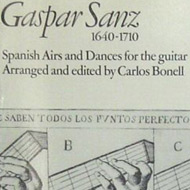
- Title: Las Folias de España in: 'Gaspar Sanz, Spanish danses and airs' (20 Spanish Airs and Dances by Gaspar Sanz)
- Published by unknown
- Score 21 x 29 cm
- Publisher No. not indicated
- Brembeck, Christian (clavichord) 'La Danza de los Poetas, harpsichord
dances'
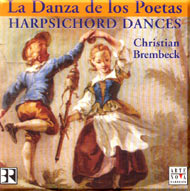
- Title: Folia
- Released 2002 by Arte Nova in Co-Production with Bayerischer Rundfunk compact disc 74321 85298 2
- Duration: 2'09"
- Recording date: May 21-23, 2001, Studio 2 Bayerischer Rundfunk, Munich, Germany
- Clavichord after Johann Christoph Fleischer (Hamburg 1729)
- Brown, Elizabeth C.D. (Baroque guitar) 'La Folía de España'
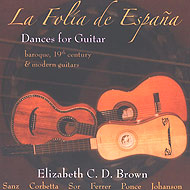 Elizabeth Brown wrote for the slipcase:
Spanish guitarist and composer Gaspar Sanz was exposed to this new style when he went to Italy to study organ and guitar. He then returned home and published the first collection of mixed rasgueado (strummend) and punteado (plucked) guitar solos in Spain in 1674. Sanz's Folia is the quintessential baroque form: a set of melodic and rhythmic variations on a chord progression, that is both dramatic and stately in feel. This particular piece has a very unusual feature: one of the variations has the phrase "esta glosada toda se corre" (this variation always is running) engraved at the beginning. This seems to be some sort of performance direction, perhaps indicating that this passage should have a faster tempo, which alludes to the wilder roots of the folia in Spain.
- Title: Folia
- Released 2005 by Rosewood Recordings compact disc ROSE 1007-CD
- Duration: 2'23"
- Recording date: Fall 2004, at Queen Anne Christian Church, Seattle, Washington, USA
- Chiaro, Giovanni De edited the music for guitar (sheet music and tablature)
- Title: Folias in: 'Treasures of the spanish guitar'
- Published by Mel Bay 1995
- Score 4 p. (sheet music and tablature) 29 x 21 cm
- Publisher No. ISBN 0-7866-0318-6
- Constantinople 'Terra Nostra'
This is an arrangement for viola da gambas, guitars and violins of the folías by Sanz (originally for guitar, 1674) and Ruiz de Ribayaz (originally for harp, 1677)- Title: Folías
- Released 2007 by Atma Classique ACD22567
- Duration: 2'48"
- Recording date: November 21-23, 2006 in Eglise Saint-François de Sales, Laval, Quebec, Canada
- Diaz, Alirio (Rizzio-guitar) 'Four centuries of music for the classical
Spanish guitar'
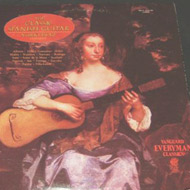
- Released 1965 by Vanguard LP VSL 11010 and as a double lp-set 'The classic Spanish guitar'
Vanguard Everyman Classics SRV 357/8 SD
Re-released Sep 3, 1996 by Vanguard Classics as compact disc (AAD) # 49, GMR 2092 - Duration: 2'30"
- Released 1965 by Vanguard LP VSL 11010 and as a double lp-set 'The classic Spanish guitar'
Vanguard Everyman Classics SRV 357/8 SD
- Diaz, Alirio (Rizzio-guitar) 'Alirio Diaz, Four centuries of music for the classical Spanish guitar'
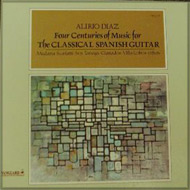
- Title: Folias
- Released by Vanguard LP VSD-71135
- Duration: 2'30"
- Diaz, Alirio (Rizzio-guitar) 'Guitarra de Venezuela'
- Title: Pavana y Folia
- Released by High Fidelity Recordings Inc. LP R812 and as a hifitape stereo tape r812 4-track 7,5 ips
- Duration of Folia: 2'56"
- Diaz, Alirio (Rizzio-guitar) '4 siècles de guitare classique'
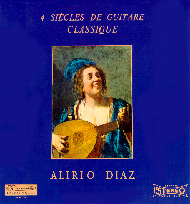
- Title: Pavana y Folia
- Released by Musidisc Gravure Universelle LP RC784
- Duration of Folia: 2'56"
- Diaz, Alirio (guitar) 'The virtuoso guitar'
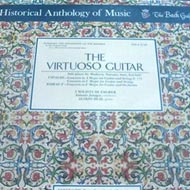 In the documentation is written:
The 17th century composer Gaspar Sanz was guitar instructor to Don Juan of Austria, and published a book, Instruccion de Musica sabre la Guitarra Espanola (1674). His Folias - a dance theme, three variations, and da capo return - is kin to the famous tune, sometimes called Folies d'Espagne, which was used for variations by a host of composers from Frescobaldi, Corelli, Vivaldi, Pasquilli and Marais to Liszt and Rachmaninoff.
- Title: Folias
- Released 1972 by Bach Guild LP HM 32 SD (originally VSD 71135/71152)
- Series: Historical anthology of music
- Diaz, Alirio (Rizzio-guitar) '5 Centuries of Spanish Guitar Music'
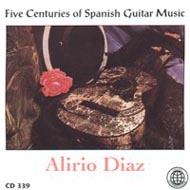
- Title: Folia
- Released by GMR compact disc 2091, cd 399
- Duration of Folia: 2'56"
- Diaz, Alirio (guitar) 'The art of the Spanish guitar'
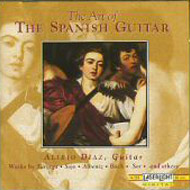
- Title: Folia
- Released 1993 by Delta Music compact disc 14 129
- Duration: 3'08"
- Recording date unknown
- Diaz, Alirio (guitar) 'The Classical Spanish Guitar'
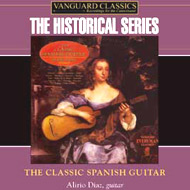
- Title: Folias (Transcription Emilio Pujol)
- Released 2006 by Vanguard Classics 2 compact disc ATMCD1802 - 0699675180225
- Duration: 3'08"
- Recording date 1977
- Diaz, Alirio (guitar) 'Alirio Diaz, five centuries of Spanish Guitar'
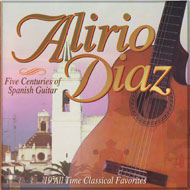
- Title: Folia
- Released 1996 by BCI Music compact disc BCCD 297, licensed from Bescol Prentice
- Duration: 3'08"
- Recording date not mentioned in the documentation
- Ensemble La Romanesca 'Música en tiempos de Velázquez'
Luis Robledo wrote for the slipcase:The Folías are a series of variations upon a basso ostinato well-known through its wide diffusion in other European countries and very well established by this time. The sterotyping of this rhythmic-harmonic model permits the happy combination of the discoveries of Sanz with the Folías of Martín y Coll.
- Title: Folías (in combination with the Folías by Martín Y Coll)
- Released by Glossa 1999 compact disc GCD 120 201
- Duration: 4'04"
- Recording date: November 1991 and April 1992 in San Lorenzo de El Escorial, Spain
- Ensemble Musica Antiqua Provence (Jean-Michel Robert: Baroque guitar, Valérie Loomer: chitariglia and cittern,
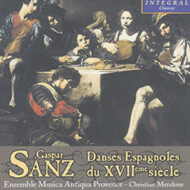 Philippe Foulon: high viol, Sergio Barcellona: tenor viol, Etienne Mangot: bass viol, Dominique Gauthier: sopranino soprano and alto recorders,
Fernand Charpentier: soprano and alto recorders, David Charpentier: soprano and alto recorders, David Mayoral: percussion and tenor recorder,
Brigitte Tramier: harpsichord) conducted by Christian Mendoze 'Gaspar Sanz, Danzes Espagnoles du XVIIème siècle'
Philippe Foulon: high viol, Sergio Barcellona: tenor viol, Etienne Mangot: bass viol, Dominique Gauthier: sopranino soprano and alto recorders,
Fernand Charpentier: soprano and alto recorders, David Charpentier: soprano and alto recorders, David Mayoral: percussion and tenor recorder,
Brigitte Tramier: harpsichord) conducted by Christian Mendoze 'Gaspar Sanz, Danzes Espagnoles du XVIIème siècle'
- Title: Folías
- Arrangement for ensemble by Dominique Gauthier
- Released 2004 by Integral Classic compact disc INT 221135
- Duration: 3'18"
- Recording date: without indication of year recorded in Château Mateus, Portugal
. - l'ensemble de trompettes baroques de Berlin (Hute Hartwich, Robert Vanryne, Stephan Maier, Ulf Behrens, trompets,
Tan Kutay, percussions, Simon Linné, Stanislaw Gojny, theorbo and baroque guitar, Mark Nordstrand organ).
- Title: Folías
- A live concert entitled 'Trompettes baroques' broadcasted by Espace 2 (Swiss) June 7, 2007
- Duration: 2'05"
- Recording date: July 4, 2006 in Varsovie
- Ferries, Gordon J.S. (baroque guitar) 'La Preciosa, The Guitar Music of Gaspar Sanz (c.1640-c.1710)'
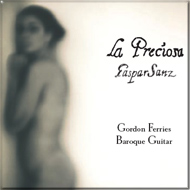
Gordon J.S. Ferries wrote for the slipcase in 2005:
Two versions of the Folia, a fifteenth-century dance, exist in the baroque era; an early and a later variant with a more complex cadential formula which became standardised in Europe. Sanz's version employs features from both. The earliest extant use of this ground appears in Mudarra's "fantasia que contrahaze la harpa en la manera de Ludovico" 15 for vihuela (1546). This generally rambunctious dance again features tambourines and a variety of other instruments and appears to have been very popular on the stage. In 1611 Sebastián de Covarrubias describes porters, in disguise, carrying young men dressed as women on their shoulders. He goes onto explain that the term folia means mad or empty headed. The steps of the dance were surely meant to illustrate this point. With its emphasis on the second beat, the folia actually has more in common with the later baroque sarabande than its namesake the Spanish zarabanda.
- Title: Folias
- Released 2004 by Delphian Records compact disc DCD34036
- Duration: unknown
- Recording date: unknown
- Fresno, Jorge (Rizzio-guitar) 'Gaspar Sanz, Instrucción de música
sobre la guitarra española'
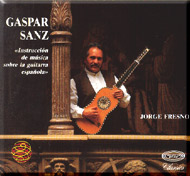
- Title: Folías (fol. 40)
- Released by Pabellon de Aragon, movieplay Portuguesa Discografica, S.A. compact disc (2-set), 3-11022/23
- Duration of Folia: 2'14"
- Recording date: March 1992 in El Monasterio de la Resurrección de Zaragoza, Spain
- Ganjavi, Reza (guitar) & Friends: Annemarie Dreyer (violin and viola),
Marianne Hübscher (flute), Matthias Schranz (viola) 'Dancing hands,
250 years of European favorites'
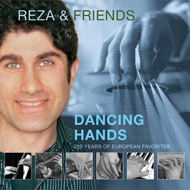 The first 4 variations are played on the solo guitar. The 4th variation
is repeated with guitar and violin, ending the piece with cello, flute,
viola and guitar in the first variation again.
The first 4 variations are played on the solo guitar. The 4th variation
is repeated with guitar and violin, ending the piece with cello, flute,
viola and guitar in the first variation again.
- Title: Folías
- Released 2003 by Reza Ganjavi Music compact disc without ordernumber
- Duration of Folia: 3'22"
- Recording date: unknown (not told), Switzerland (without location), 2003
- More about the performer at:http://www.rezamusic.com
- Henderson, Eric (guitar) 'Castillian Knights'
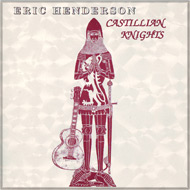
- Title: Folias, Suite Espanola
- Released by not mentioned label or ordernumber
- Duration: 2'45"
- Recording date: Without indication of year at Westside Recording (without further details of the location)
- I Villani (ensemble with recorder, guitar, bass and percussion) 'L'altra musica antica'
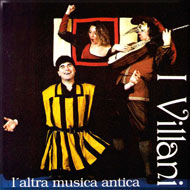
This is a nice arrangement for recorder, guitar, bass and percussion of the Folia entirely based upon the piece written by Sanz for guitar solo.
Michael Angierski (guitar) wrote in an e-mail the 7th of January 2006:
Duration: 2'43", 1.6 MB. (96KB/s, 44100 Hz)
A fragment of the arrangement
© 1993 I Villani, used with permission
The arrangement, which follows quite close to the Sanz original from the "Libro Segundo de Cifras sobre la Guitarra Espanola" (1673), was composed in 1992 and first performed by "I Villani" in the same year.
- Title: 'La Folia'
- Released 1993 by Hohner Records compact disc HR.08.099.172 / LC 0779
- Duration: 3'24"
- Recording date: 1993 in Sandhausen, Germany
- More about Michael Angierski at his page http://homepage.michael-angierski.info/index.htm and information about the ensemble I Villani at http://www.offsetprint.de/ivillani/index.jsp
- Indiana University Renaissance Band/John Raymond Howell
- Title: Folias
- Recorded by Indiana University, School of Music in Bloomington
- Sound tape reel 1974-1975 no. 702
- Recording date: April 11, 1975
- Kithara: Wilson, Christopher (5 course baroque guitar in E, built by
Robert Eyland 1974) and Miller, David (14 course theorbo in A built by
Stephen Barber 1982), Musica Mediterranea, Music of the Italian &
Spanish Renaissance
 The seven variations of the Folia are attributed to an anonymous composer.
However two variations are obviously arrangements of two variations by
Gaspar Sanz (variation 4 and 5). The other variations might be improvisations
regarding the quote of Dinko Fabris comment
The seven variations of the Folia are attributed to an anonymous composer.
However two variations are obviously arrangements of two variations by
Gaspar Sanz (variation 4 and 5). The other variations might be improvisations
regarding the quote of Dinko Fabris comment
Dinko Fabris wrote for the slipcase:We are presented with the joyful use of variation, and free improvisation by the musicians on the most popular themes of the day. This is a freedom which, for several centuries, European musicians seemed to forgot.
- Title: Folias
- Released by Chandos August 1994 compact disc Chan 0562
- Duration: 3'38"
- Recording date: November 17-19, 1993 in Orford Church, Suffolk England
- La
Galanía (Jesús Fernández Baena: theorbo, Pierre Pitzl: baroque guitar)
- Title: Folías/Improvisación
- Released 2011 by Anima e Corpo Música compact disc AEC001
- Duration: 2'41"
- Recording date: unknown
- La Galanía (Jesús Fernández Baena: theorbo, Pierre Pitzl: baroque guitar)
- Title: Folías/Improvisación
- Broadcasted by the Spanish radio Quincena Musical de San Sebastián Transmisión directa desde el Convento de Santa Teresa de San Sebastián. Ciclo de Música Antigua. (direct broadcast during a live performance)
- Duration: 3'59"
- Recording date: August 10, 2012 from the Convento de Santa Teresa in Sebastián, Spain
- Lacrimae Ensemble (Regina Albanez: baroque guitar) 'Flow my tears'
- Title: Folias (with improvised prelude)
- Released 2005 by Skarster Music Investment compact disc (SACD) ACD HL 005-2
- Duration: 1'42"
- Recording date: August 2-4, 2005 at the Nederlands Hervormde Kerk Kolham, The Netherlands
- Lautten Companey 'Konzertsommer 1999'
- Folias
- Released 1999 by PricewaterhouseCooper 3 cd-box
- Duration: 3'33"
- Recording date: 1999 without indication of place and date
- Lemaigre, Philippe (guitar)
- Title: Folias
- Released by ALP DB 234
- Lindberg, Jakob (5 course baroque guitar) 'Spanish guitar music'
- Folias
- Released 2000 by BIS compact disc BIS-CD-899
- Duration: 1'46" (theme, 3 variations, theme)
- Recording date: February 1999 at Länna Church, Sweden
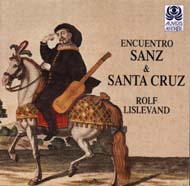
- Lislevand, Rolf (5 course guitar) "Encuentro Sanz & Santa Cruz"
- Released 1997 by Avidis Astree compact disc E 8575
- Duration: 1'27" (theme, 3 variations, theme)
- Recording date: November 1995 in l'Abbatiale de Beinwil, Soleure Zwitserland
- Lislevand, Rolf (baroque guitar)
- Broadcasted by KRO Radio (The Netherlands), September 10, 1998 of a live concert
- Duration: 1'20"
- Recording date: August 30, 1998 in the Ottone at the 'Festival of Ancient Music', Utrecht
- Lislevand, Rolf (guitar) 'Altre Follie'
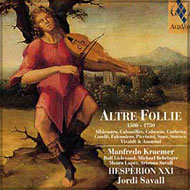 This Folias tune of the compact disc 'Altre Follie' is a combination of different lines from the Folia
composition by Corbetta and by Sanz. The opening is for the Corbetta strummed lines followed by the theme of Sanz.
The music swiches several times between the two pieces.
Overall, one can globally identify the Corbetta elements by the strummming style and the Sanz lines by the plucked
style.
This Folias tune of the compact disc 'Altre Follie' is a combination of different lines from the Folia
composition by Corbetta and by Sanz. The opening is for the Corbetta strummed lines followed by the theme of Sanz.
The music swiches several times between the two pieces.
Overall, one can globally identify the Corbetta elements by the strummming style and the Sanz lines by the plucked
style.
Rui Vieira Nery wrote for the slipcase:
Corbetta seems to be one of the first authors to superimpose to the traditional bass of the Folia the characteristic treble melody in triple meter, with a dotted second beat in each measure, that was to become associated with the genre from the late seventeenth century on. In fact, Gaspar Sanz' 1674 version was basically an adaptation of Corbetta's setting., which the Spanish master must have acquired shortly after its publication in Paris.
- Title: Folias (1674)
- Released 2005 by Alia Vox compact disc AV 9844
- Duration: 3'14"
- Recording date: February 28-March 3 and June 6-9, 2005 in the Collégiale of the Château de Cardona, Catalogne
- See also the page Recommended Folia-recordings
- Lopátegui, José Luis (guitar) 'Spanish Guitar Music'
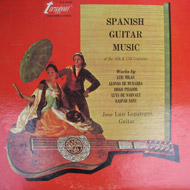
- Title: Folias of Suite Espagnol
- Released unknown year by Turnabout LP TV-S 34390
- Duration of Folia: 3'15"
- Recording date: not mentioned in the documentation
- Lundestad, Sven (guitar) 'Rendez-vous'
- Title: Folias
- Released 1995 by Okapi Records compact disc ORCD 001
- Duration of Folia: 2'36"
- Recording date: November 17, 1994 and January 26 and February 10, 1995
- Mailburg, Anette (flute), Potasinski, Leszek (guitar), Gula, Wlodzimierz (double bass) 'La Fiesta'
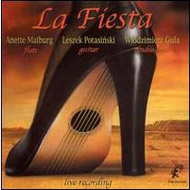
- Title: Folías
- Released 2000 by Zuk Records compact disc 319
- Duration of Folia: 2'49"
- Recording date: unknown
- Maroto, Sebastian (guitar) 'La Guitare Espagnole'
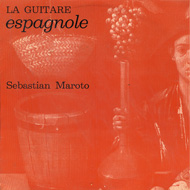
- Title: Folia
- Released by Harmonia Mundi vinyl HMO 25.302
- Duration: 2'30"
- Recording date: not mentioned in the documentation
- Mason, Barry (baroque guitar) 'Masters of the baroque guitar
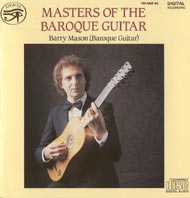
- Title: Folia
- Released 1990 by Amon Ra compact disc CDSAR 45
- Duration: 2'20"
- Recording date: December 1988 at West Dean, Sussex
- Guitar by Klaus Jacobsen, London 1977 after Vovam, France mid 17th century
- Martinez, David (guitar) 'Guitar Recital'
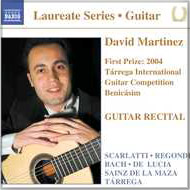 This is an early arrangement of the Folias by Sanz which differs not that much from the more common
arrangements for modern classical guitar. However for this recording not Sanz but Regino Sainz de la Maza
is mentioned as the composer.
This is an early arrangement of the Folias by Sanz which differs not that much from the more common
arrangements for modern classical guitar. However for this recording not Sanz but Regino Sainz de la Maza
is mentioned as the composer.
In the slipcase is written:
Regino Sainz de la Maza (1896-1981)4 Danzas Cervantinas (after Gaspar Sanz) Folias, Españoleta, Marizapolos, Canarios. A leading guitarist, composer and teacher of his time, Regino Sainz de la Maza has also earned a mark in history by being the first performer of the most played concerto ever, Rodrigo's 'Concierto de Aranjuez'.
Many of Sainz de la Maza's compositions are flamenco-based, but another passion was the Baroque. and the four 'Danzas Cervantinas' constitute in effect a homage to the great master of the Baroque guitar, Gaspar Sanz (1640-1710). The dances transfer wellfrom the Baroque guitar to the modern guitar, once the six single strings of the modern guitar can be reconciled with the five double strings of the Baroque instrument.
Saionz de la Maza's rescue work was done before the Early Music movement got into its stride, and the musical values of his time were unimpeded by questions of authenticity.- Title: Folias as part of Danzas Cervantinas
- Released 2005 by Naxos Laureate Series - Guitar compact disc 8.557808
- Duration: 1'55"
- Recording date: April 22-24, 2005 at St.John Chrysostom Church, Newmarket, Ontario, Canada
- Martinez, Kurt (guitar) 'Folías'
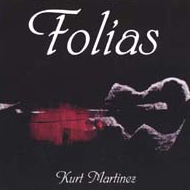
- Title: Folias
- Released without indication of year (but it is 2003) by martinezkurt@cs.com without order number
- Duration: 3'16"
- Recording date: not mentioned in the slipcase
- See also the page Recommended Folia-recordings
- Moreno, Jose Miguel (vihuela or baroque guitar or guitar) 'La guitarra
española (1536-1836)'
- Title: Folias
- Released 1994 by Glossa, San Lorenzo de el Escorial, Espana compact disc 920103
- Duration: 3'48"
- Recording date: March 1994, at Villa Consuelo, San Lorenzo de El Escorial
- Moreno, Jose Miguel baroque guitar ) and Orphénica Lyra: Eligio Quinteiro, tiple and theorbo, Juan Carlos de Mulder, theorbo and baroque guitar, Pedro Estevan, percussion "Gaspar Sanz, Instrucción de música sobre la guitarra Española"
- Title: Folias
- Released 2008 by Glossa compact disc GCD C80206
- Duration:unknown
- Recording date: April 2000 at Sama de Langreo (Auditorio del Conservatorio de la Mancomunidad del Valle del Nalón)
- Moreno, Jose Miguel (vihuela)
Jose Miguel Moreno in a live performance of Folias and Canarios
Duration: 7'06" direct link to YouTube
© 2007 by Jose Miguel Moreno- Title: Folias and Canarios by Lucas Ruiz de Ribayaz based upon Gaspar Sanz
- Broadcasted by ORF O$uml;sterreichischer Rundfunk January 26, 2007 in the program `Resonanzen`.
- Duration: 7'06"
- Recording date: January 26, 2007 (a direct broadcasting) location unknown
- Navascués, Santiago (guitar) 'Spanische Gitarrenmusik, Santiago Navascués spielt Albéniz, de Falla, Rodrigo, Sanz, Turina'
- Title: 12 Tänze aus Instruccion de musica sobre la Guitarra Espanola: Folias
- Released 1973(?) by Ariola LP 86853 KK
- Duration: 2'45"
- Recording date: May 1973 in Berlin, Germany
- Olavide, Begoña (salterio), Paniagua,
Carlos (darbugas, psalterion) e.o. 'Salterio'
This is a Folia-medley starts with an anonymous Folia including some variations by Gaspar Sanz, the second Folia is played as an improvisation by the ensemble and the last part is the Barcelona Manuscript for salterio solo dated back to 1764.
- Released January 1999 by MA Records compact disc MA 025A
- Duration: 10'31"
- Recording date: March 1994 in the Monasterio de la Santa Espina, Valladolid, Spain
- Orphénica Lyra [Moreno, José Miguel (baroque guitar),
Mulder, Juan Carlos de (theorbo), Quinteiro, Eligio (tiple)] 'Gaspar Sanz,
Instrucción de música sobre la guitarra española' '
- Title: Folías
- Released 2000 by Glossa, in the series The Spanish Guitar Vol. V compact disc GCD 920206
- Duration: 3'12"
- Recording date: April 2000 in Auditorio del Conservatorio de la Mancomunidad del Valle del Nalón
- Parkening, Christopher (guitar) 'A Tribute to Segovia'
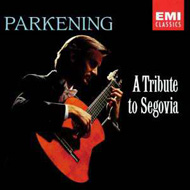
- Title: Suite española: Folias
- Released Nov 12, 1991 by EMI Classics compact disc 49404
- Pujol, Emilio. Transcription for guitar from guitar tablature
- Published 1928 by Max Eschig Editions, anciens 1006 M.E. 2096
- Part of: Les guitaristesespagnols du XVIIe siecle
- Score 3p., 32 cm.
- Rigano, Paolo (Baroque guitar) 'La Chitarra alla Spagnola: 17th Century Music for Baroque Guitar'
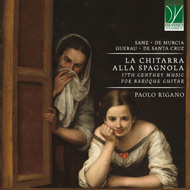
- Title: Folias
- Duration: 2'28"
- Released by Da Vinci Classics compact disc
- Year of release: 2024
- Robert, Jean Michel (lute) Tramier, Brigitte (harpsichord) "Musique
baroque pour luth, chitarrone et clavecin"
This is a nice medley of the authentic score for keyboard by Pasquini with a lute-part added and the authentic score for guitar (in this case lute) by Sanz with a harpsichord-part added. And that's not all. Every variation of Pasquini is immediately followed by a variation of Sanz and every variation of Sanz by a Pasquini-variation till all variations have been played.- Title: Variations sur "Les Folies d'Espagne"
- Duration: 3'33"
- Released by Koch Schwann compact disc 3-1544 2
- Recording date: October 1991 dans la salle de concerts, Centre Culturel de Valprivas, France
- Santos, Turibio (guitar) 'Concierto de Aranjuez: Rodrigo, Sor, Sanz,
Mudarra, de Narvaez'
- Suite Espanole: Españoleta, Rujero y Paradetas, Folias de España, Zarabanda al aire español, Toques de la Caballeria de Napoles, Canarios
- Released without indication of the year of release by Musidisc LP 30 RC 894
- Duration: 3'18" (just the Folias de España)
- Recording date: not indicated
- Sauvage, Valéry
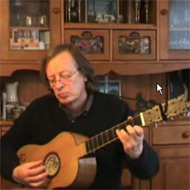
Duration: 1'51" direct link to YouTube
The complete Folias as played by Valéry Sauvage
© 2008 Valéry Sauvage, used with permission- Title: Folias from the 'Instruccion de Musica sobre la guitarra española (libro segundo, f. 40r).
- Baroque guitar strung with nylon strings
- Released for YouTube December 30, 2008
- More about Valéry Sauvage at http://perso.orange.fr/luthval/discographie.html
- Scheit, Karl edited the music for guitar
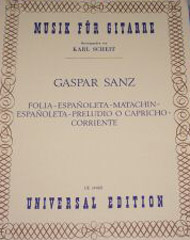
- Title: 'Folia - Espanoleta - Matachin - Espanoleta - Preludio o Capricho - Corriente' (aus 'Instruccion de Sobre la Guitarra Espanola', 1674)
- Published 1974 by Universal Edition
- Score 8 p. in total 23,2 x 30,5 cm
- Publisher No. UE14469
- ISMN M-008-00536-7
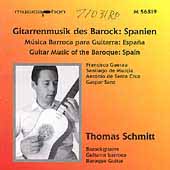
- Schmitt, Thomas (guitar) 'Gitarrenmusik des Barock - Spanien'
- Title: Folias
- Released 1996 by Musicaphon (distributed by Qualiton) as compact disc 56819
- Duration: 1'43"
- Smith, Hopkinson (5 course guitar) 'Instrucción de música
sobre la guitarra'
- Title: Foliís, baile aristocratico algo estilizado (stylized aristocratic dance)
- Released 1996 by Auvidis Astree compact disc E 8576
- Duration: 2'25" (theme, 3 var., repetition of the 3 var., theme)
- Recording date: December 1995 in Mandelsloh, Neustadt Germany
- Smith, Hopkinson (baroque guitar) 'Sanz, Instrucción de música
sobre la guitarra'
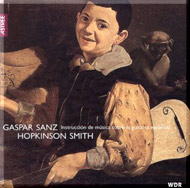
- Title: Foliís, baile aristocratico algo estilizado (stylized aristocratic dance)
- Released 2000 by NAIVE Astree compact disc 8828
- Duration: 2'29" (theme, 3 var., repetition of the 3 var., theme)
- Recording date: unknown
- Takeuchi, Taro (5 course guitar) 'Folias!, virtuoso guitar music of
C17th on period instruments'
- Title: Folias
- Released 2002 by Deux-Elles Limited, Reading, UK compact disc DXL 1030
- Duration: 3'29"
- 5 course guitar by Martyn Hodgson , Leeds 1982 after René Voboam, Paris, 1641. he original is in the Hill Collection, Ashmolean Museum, Oxford
- Recording date: April 16 and 17 at St Martin's Church, East Woodhay, England
- Terrago, Renata (5 course guitar) 'Three centuries of Spanish guitar music'
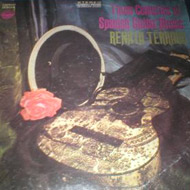 Renata Terrago was born in Barcelona, where she studied music at the conservatory of the Liceo.
She began her career as a professional guitarist when she was
fourteen. Both in Spain and abroad, her recitals have met acclamation from the public and critics.
In 1951, the city of Barcelona awarded her the Premio Extraordinario (award for excellent achievement).
Renata Terrago was born in Barcelona, where she studied music at the conservatory of the Liceo.
She began her career as a professional guitarist when she was
fourteen. Both in Spain and abroad, her recitals have met acclamation from the public and critics.
In 1951, the city of Barcelona awarded her the Premio Extraordinario (award for excellent achievement).
The Album cover says the following:Gaspar Sanz lived during the Seventeenth Century, and spent most of his career away from Spain. He became maestro to the Spanish Viceroy at Naples and guitar teacher to Don Juan of Austria, for who he wrote a book of instruction which contains interesting examples of Spanish dance music and folksong of that period.
- Title: Folías
- Released by Everest Productions LP without indication of year
- Duration: 1'34"
- Recording date: not mentioned in the documentation
- Terrago, Renata (5 course guitar) 'Musique Espagnole pour guitare'
- Title: Folías
- Released by Vega Serie Artistique LP HH C 30 A 249
- Duration: 1'37"
- Torre, Rey de la (guitar) 'Music by Guliani, Sanz, Sor, Tárrega, Toroba'
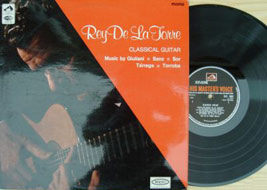
- Title: Folías
- Released 1958/1959 by His Masters Voice LP CLP 3607
- Duration: unknown
- Vidal, Marcelo (guitar) 'La guitarra en la iglesia'
- Title: Folías
- Released 2005 by Balcon Records compact disc BCR 62604
- Duration: 2'10"
- Walter, Fried 'Reflexe, Variationen durch
die Jahrhunderte über ein altspanisches Thema von Gaspar Sanz (1972).
Walter uses the opening variation of Sanz to create his own musical time travel. See for more information at the composer Walter or click the link. - Yepes, Narciso (ten-stringed guitar) 'Narciso Yepes, Spanish guitar
music'
- Title: 'Folias' as part of the 'Suite Española'
- Released 1997 by Belart,a Polygram company compact disc 461 2762
- Duration: 2'31"
- Recording date: 1968
- Yepes, Narciso (ten-stringed guitar) 'Guitarra Española, Vol 1'
- Title: 'Folias'
- Released 1968 Polydor International, 1992 Deutsche Grammophon 4x compact disc 439 172-2
- Duration: 2'31"
- Recording date: September 1967, Beethovensaal, Hannover, Germany
- Yepes, Narciso (ten-stringed guitar) 'Malaguena: Spanish guitar music'
- Title: 'Folias'
- Released March 2001 by Deutsche Grammophon compact disc 2894696492
- Duration: 2'30"
- Recording date: September 1967, Beethovensaal, Hannover, Germany
- Yepes, Narciso (ten-stringed guitar) 'Cinco Siglos de Guitarra Española, VL. 1'
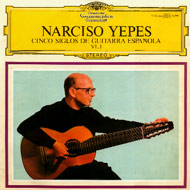
- Title: 'Folias' as part of the 'Suite Española'
- Released 1968 by Deutsche Grammophon Gesellschaft LP ALB 216 139 365
- Duration: 2'30"
- Recording date: September 1967, Beethovensaal, Hannover, Germany
- Yepes, Narciso (ten-stringed guitar) 'The World of Guitar Vol. 1'
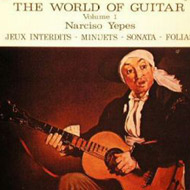
- Title: 'Folias' as part of the 'Suite Española'
- Released unknown by London Label LP SPA 4005
- Duration: 2'30"
- Recording date: September 1967, Beethovensaal, Hannover, Germany
- Yepes, Narciso (ten-stringed guitar) 'Barockwerke für Gitarre,
J.S. Bach, D. Scarlatti, Weiss, Sanz'
- Title: 'Folias' as part of the 'Suite Española'
- Released without an indication of the year by Deutsche Grammophon LP 2538236
- Duration: 2'28"
- Recording date: not indicated
- Yepes, Narciso (ten-stringed guitar) 'Narciso Yepes'
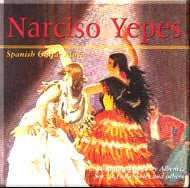
- Title: 'Folias'
- Released without an indication of the year by London Continental series LP KL-320
- Duration: 2'28"
- Recording date: not indicated
- Yepes, Narciso (ten-stringed guitar) 'Narciso Yepes'
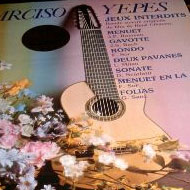
- Title: 'Folias'
- Released 1956 Disques Festival LP Vinyl FLD 718
- Duration: 2'34"
- Recording date: not indicated
- Zaczek, Brigitte (guitar) 'Music for guitar from the Spanish renaissance
and rococo'
- Title: Folias
- Released 1969 by Musical Heritage Society LP MHS 991
- The works by Sanz are from his book, 'Instrucccion de musica sobre la guitarra espagnola' (Zaragosa 1674) for five-course baroque guitar. Played here on the modern guitar.
- Zayas, Rodrigo de (Baroque guitar) 'Luths - Théorbes, Vihuelas, Guitare Baroque'
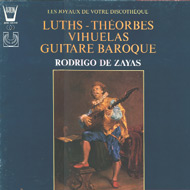
Rodrigo de Zayas wrote as an introduction to the piece: (the statement of Piccinini's 'early' folí will be a misunderstanding)
Folías: the first report of a folía appears when one was danced for Queen Juana la Loca during a trip to Portugal, in the town of Evora. The Portuguese origin of this dance is therefore probable. This same folía appeared among the works for the theorbo of Piccinini written at the beginning of the 17th century long before Sanz.
- Title: Folías
- Released 1979 by Arion 3 LP-set ARN 336 018
- Duration: 1'21"
- Recording date: 1978 in la Maison de la Culture de Rennes, France
Variazioni su "La Follia" for keyboard (1723), also known as Toccata VII Primo tono with Folia for Keyboard, 29 'eight-bars' variations is the best known. It is the last part of a set called d'Ottava stesa. These are amazing dances before the Follia sets in. The structure of these variations keeps within bounds of the first 8 bars of the Foliatheme and even the last bar is consequently in the dominant (and not in the expected tonica)
The original manuscript conserved in Naples (Conservatory Library, manuscript 9478: Primo e Secondo Libro di Toccata del Sig. Cavaglere Alessandro Scarlatti).
The complete d'Ottava stesa as played by Andrea Marcon (harrpsichord)
|
|
Theme and variazioni su "La Follia" |
|
Duration: 1'30", 531 kB.( 48kB/s, 11KHz) |
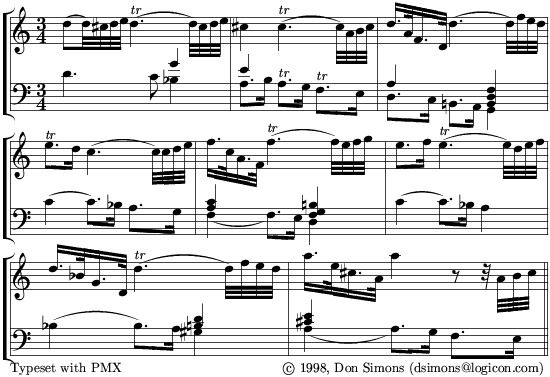
| Theme of Variazioni su 'La Follia' | by unknown source |
|---|---|
 |
|
- Alessandrini, Rinaldo (harpsichord) 'Toccate per Cembalo'
Alessandrini plays d'ottava stesa including Follia
Duration: 22'44", Follia starting at 11'11" direct link to YouTube
© 1992 by Rinaldo Alessandrini- Title: Toccata per l'ottava stesa (1723)
- Released 1992 by Arcana compact disc A3, re-released 2010 by Arcana compact disc A323
- Duration: 8'20" as part of the Toccata per l'ottava stesa (total time 19'28") not indexed at all
- Recording date: october 8/10 1991 in the studio of Deutschlandfunk, Koln (Cologne)
- Harpsichord built by Franciscus Debbonis, Roma 1678
- Alvini, Laura (harpsichord) 'Studii e divertimenti percembalo: Francesco
Durante, Con due toccate; Variazione sulla Follia di Alessandro Scarlatti'
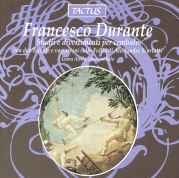
- Released 1994 by Tactus compact disc TC 680402
- Duration: 7'32"
- Bärtschi, Werner (piano) 'La Folia'
- Title: Folia
- Released 1983 by PAN LP ordernumber 130 051
- Duration: 7'44"
- Recording date: February 2nd in Thun Switserland, 1982
- See also the page Recommended Folia-recordings
- Battiston, Ivano (accordeon solo)
Ivano Battiston plays La Follia
Duration: 12'38" direct link to YouTube
© 2010 by Ivano Battiston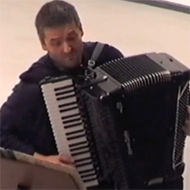
- Title: La Follia
- Published at YouTube October 6, 2010 by Ivanobattiston
- Duration:12'38"
- Recording date:24 August 2002 in Kunstlerhaus Bethanien, Berlin, Germany
- Brembeck, Christian (harpsichord) 'La Danza de los Poetas, harpsichord
dances'
- Title: Variazoni sulla Follia di Spagna
- Released 2002 by Arte Nova in Co-Production with Bayerischer Rundfunk compact disc 74321 85298 2
- Duration: 7'13"
- Recording date: May 21-23, 2001, Studio 2 Bayerischer Rundfunk, Munich, Germany
- See also the page Recommended Folia-recordings
- Catalucci, Gabriele (harpsichord) 'Festival internationnal de l'orgue ancien et de la musique ancienne VOL 5'
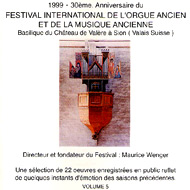
- Title: Follia
- Released 1999 by Festival International de l'orgue ancien et de la musique ancienne compact disc without an ordernumber
- Duration: 2'19"
- Recording date: 1998 in Basilique de Château de Valère in Sion, Switzerland
- Dawson, Lynn & The Purcell Quartet 'La Folia & Two Cantatas'
- Released 1989 by Hyperion compact disc CDA66254
- Duration: 13'04"
- Recording date: April 29/30, 1987
- Dawson, Lynn 'La Folia'
- Released 1992 by Hyperpress Pub. Corp.
- Source: CDNow with ISBN 6302005116
- Esfahani, Mahan (harpsichord)
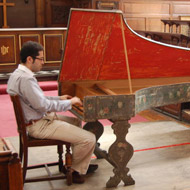
Mahan Esfahani plays Variazoni sulla Follia di Spagna
Duration: 6'34" direct link to YouTube
© 2010 by Mahan Esfahani- Title: Variazioni sulla Follia di Spagna
- Broadcasted by BBC radio 3 in the program 'Lunchtime concert' 14 Jul 2010, 13:00 from a live performance with the title "Harpsichord Music from the court of João V" during the 'City of London Festival 2010'
- Duration: 6'35"
- Recording date: June 29, 2010 in Church of St Margaret Pattens, London England during the 'City of London Festival 2010'
- Thanks to Sagittarius for publishing the concert in the newsgroup alt.binaries.sounds.mp3.classical August 8, 2010
- Frigè, Milena (harpsichord) 'Alessandro Scarlatti, Toccate per
Clavicembalo e per Organo'
- Title: Variazioni su "La Follia"
- Released 1995 by Stradivarius compact disc STR 33386
- Duration: 9'42"
- Recording date: November 21/23, 1994 in the Aula magna del Seminario Superiore di Ivrea, Italy
- Gaggini, Marco (harpsichord)
Duration: 7'40" direct link to YouTube
Follia from Settima Toccata as played by Marco Gaggini
© 2009 Marco Gaggini and Romeoamkj, used with permission- Title: Variazioni su "La Follia"
- Recorded by Romeoamkj during Rassegna Cembalistica 2009
- Duration: 7'40"
- Recording date: March 21, 2009 at Palazzo Annibaldeschi in Monte Compatri, Rome, Italy
- Galvez, Genoveva (harpsichord) 'Espana en la Musica Europa de los Siglos XV al XVIII'
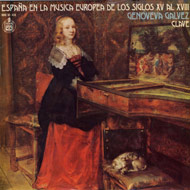
In the documetation was written by Genoveva Galvez:Duration: 7'05" direct link to YouTube
Follia from Settima Toccata as played by Genoveva Glvez
© 1977 Genoveva GalvezLa «Folía» es una danza portuguesa, cuyo origen se remonta a tiempos muy antiguos. Ya Pedro 1, al Justiciero, de Castilla, en el 1350, gustaba de bailarla, A partir de 1500 se leen alusiones frecuentes a esta danza en tratadistas de música como Salinas, en literatos (Gil Vicente, Cervantes .. . ), encontrándose, por otro lado, gra'n cantidad de ejemplós musicales de ella en vihuelistas y cancioneros. A principios del siglo XVII, se pone de moda en toda Europa, con el nombre de «Folía de España» ; casi todos los compositores escribieron sobre este tema, baste decir que, en tiempos más modernos, hasta Liszt y Rachmaninoff han utilizado el tema de la «Folía» en sus composiciones.
Alessandro Scarlatti (1660-1725), padre de Domenico, el autor de tantas bellas sonatas para e,1 clave, había trabajado con el gran Girolamo Frescobaldi en Roma; de él aprendería la técnica de la Variación, o «Partite», en la acepción italiana más antigua de esta palabra. Existe, según Willy Apel, un vínculo de unión entre Cabezón y Frescobaldi a través de la escuela de tecla de Nápoles, y de la que son exponentes magníficos un Antonio Valente y otros compositores. La «Folía», primitivamente danza, se , convierte en tema básico de composición, y se presenta como complejo armónico-melódico en el que están implicadas las cuatro voces polifónicas (según el mUSicólogo Miguel Quero!), pero cuya parte más característica se sitúa en el bajo. Este bajo de «Folía», se repite invariablemente a lo largo de la obra como un bajo «ostinato». La «Folía» de A. Scarlatti, de gran empeño virtuosístico, forma parte integrante de una de sus «Toccatas».- Title: Partite sull'Aria della Follia
- Recorded 1977 by Hispavox HHS 10-474 (LS)
- Duration: 7'05"
- Recording date: not mentioned in the documentation
- See also recommended recordings
- Garilli, Fabrizio (harpsichord) 'Il '700 Musicale Italiano'
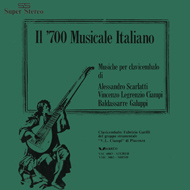
- Title: Variazioni sulla Follia
- Released by Disco VMC 3003 mono - VSC 4003 Stereo Vedette Classica
- Duration: unknown
- Recording date: unknown
- Gerlin, Ruggero (harpsichord) 'Spanish and Portuguese Masters of the
Harpsichord'
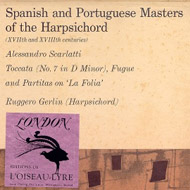
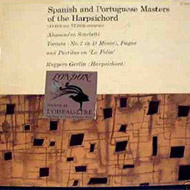
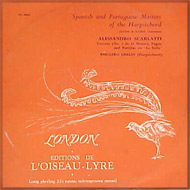
In the documentation was written:
The Toccata No. 7 in D minor appears in the manuscript of the two books of 'Toccate per Cembalo'. The second part of this toccata comprise twenty-nine variations on the 'Folia', popular theme of an old Spanish dance, in ternary rhythm. A detailed description of this dance was given by Salinas in in the seventh book of his 'De Musica' (1577). In 1600 Cervantes mentioned it, placing it with the saraband and the chaconne, and in 1625 Giovanni Stefani used it in his 'Scherzi amorosi'. A number of composers in addition to Scarlatti took up the theme, including Fresobaldi, Storace, Pasquini, Corelli, d'Anglebert, Bach, Sanz, Lully, Vivaldi, Keiser, Pergolesi, Grétry and Cherubini.
- Title: Partitas on "La Folia"
- Released mid 1950s by L'Oiseau Lyre LP OL 50032
- Duration: 9'53" (as part of the complete Toccata in D minor)
- Recording date: mid 1950s
- More about Ruggero Gerlin at the website http://jsebestyen.org/gerlin/
- Goebels, Franzpeter edited the sheet music
From the preface:Out of the wealth of Follia compositions traceable from the late 15th century up to the turn of the 20th, we are publishing three salient works for the keyboard. Our edition is based on a critical revision of the source material.
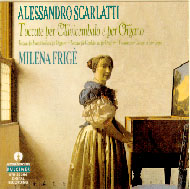
- Title of volume: Variationen über die Follia für Klavier. (incl. C.P.E. Bach & Pasquini)
- Title: Variazioni sulla 'Follia di Spagna' (theme and 28 variations)
- Published by Schott, Mainz 1970
- In a footnote at variation 28 the editor writes: 'This may not be regarded as a suitable ending to the work. The editor follows it by a repetition of variation 24 with the perfect cadence'.
- Publisher No. ED5775
- ISMN: M-001-06326-5
- Innocenti, Stefano (organ) 'Neapolitan Keyboard Music'
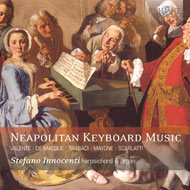
- Title: Partite di Follia
- Released 2014 by Brilliant Classics
- Duration 8'22"
- Recording date: 21 July 2013 in Parma
- Jensen, Lori-Ann editor and arranger of adapted score for any three
suitable instruments.
Duration: 0'28", 02 kB.
The theme as indicated in the sheet music for koto, steel string guitar & dulcimerOpening theme by A. Scarlatti. Arranged and edited for 3 instruments by Lori-Ann Jensen
© 1995 Podium Music, reproduced with permission of Podium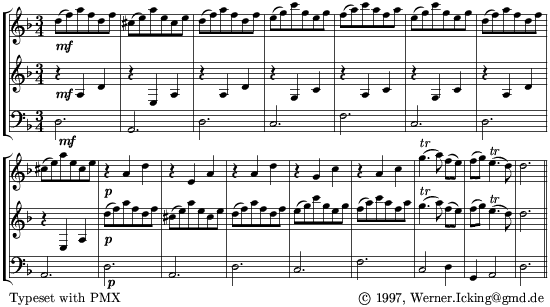
- Published 1995 © by Podium Music, Canada
- Score 4 p. (66 bars), 23 cm by 17 cm
- Publisher No. 3800
- See the sheet music above, where the opening is shown
- Kipnis, Igor (harpsichord) 'Italian Baroque Music for Harpsichord'
Judith Robison wrote as an introduction:In this recording, Mr. Kipnis has made a keyboard transcription of Corelli's setting of the theme to open the variations and uses a theme from Vivaldi's Trio Sonata, Op. 1, No. 12 to close them.
- Title: Toccata in D minor
- Released 1966? by Epic LP BC 1311
- Duration: 19'40" (complete toccata) 10'39" (variations)
- Recording date: October 8, 11 and 12, 1965 at Columbia's 30th Street Studio, New York City
- Kipnis, Igor (harpsichord) 'Europäische Cembalomusik des Barock und Rokoko'
 Ekkehart Kroher wrote as an introduction:
Scarlatti hinterliess kein grossartigeres Werk als die dreiteilige Toccata d-moll, deren abschliessendes 'Partite sull' aria dell' follia' 29 Variationen über das durch Corellis Violinsonate op. 5 Nr. 12 berühmt gewordene Folia-Thema bringt
- Title: Toccata nr. 7 in D minor
- Released without indication of year by CBS LP 5-box S77501
- Duration: 19'40" (complete toccata) 10'39" (variations)
- Recording date: October 8, 11 and 12, 1965 at Columbia's 30th Street Studio, New York City (not indicated in the documentation)
- Koppenwallner, Angela (harpsichord) 'Alessandro Scarlatti & Figlio, musica per il clavicembalo'
- Title: 29 Variationen über 'La Follia'
- Released 2006 by ORF Edition Alte Musik compact disc 458
- Duration: 11'13"
- Recording date: July 18, 19 2005 in Neander-Kirche, Düsseldorf, Germany
- Harpsichord built by Joel Katzman, 1995 Amsterdam
- Laganà, Ruggero (harpsichord) 'Follie, bizzarrie e stravaganze in musica, dal '500 all '800'
 Source: GB-Lbl, una più tarda versione in US-NH, in Toccate per cemalo, a cura di J.S. Shedlock, London 1908
- Title: Variazioni sopra la Follia di Spagna (1723)
- Released 2005 by Amadeus Darp, Milano, Italy double compact disc AMS 092-2 DP together with a magazine special devoted to the Folia Theme (April 2005)
- Duration: 8'24"
- Recording date: August 18-19 and November 15-19, 2004 in Chiesa di S. Maria Incoronata, Martinengo (Bg), Italy
- All variations nicely indexed
- See also the page Recommended Folia-recordings
- Laganà, Ruggero (harpsichord) 'Folías italianas'
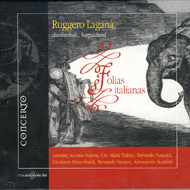 Pinuccia Carrer wrote for the slipcase:
As Pasquini, so was Alessandro Scarlatti (Palermo, 1660 - Naples, 1725), an Arcadian with the name Terpandro, who played a big role within music history as a composer-teacher as well as father (Pietro and Domenico were his most well known offspring, and it was he himself who introduced them to the art of music). Alessandro Scarlatti made the toccatistica form and the Folie d'Espagne his, developing each single variation, from the point of view of keyboard technique, in a truly original manner. In order to show the harpsichord's obvious and hidden tonal and dynamic resources to their advantage he surrounds his writing with a veritable "cacophony" of chords and formulas, dictated more by him than rules. They are placed at the end of the CD and would appear to be a musical metaphor of Enconium moriae, in praise of folly, recalling Erasmus.
- Title: Toccata per cembalo d'Ottava stesa (1723) (with), Variazioni sulla Follia di Spagna
- Released 2010 by Concerto compact disc CD 2058
- Duration: 18'52"
- Recording date: October 2009 Bartok Studio, Bernareggio (Mi), Italy
- See also the page Recommended Folia-recordings
- Laganà, Ruggero (harpsichord)
Ruggero Laganà plays Variazoni sulla Follia di Spagna live in Rome
Duration: 7'28" direct link to YouTube
© 2010 by Ruggero Laganà- Title: Variazioni sopra la Follia di Spagna (1723)
- Broadcasted live of performance by Italian radio Rai Radio 3
- Duration: 8'27"
- Recording date: 28 October 2007, Palazzo del Quirinale, Roma, Italy
- Longo, Alessandro editor 'Aria con variazioni per pianoforte di Alessandro
Scarlatti'
- Title: Variations on 'Folies d'Espagne'
- Published 19? by G. Ricordi, Milano-New York
- 15 p, 32 cm
- Series: Biblioteca del pianista
- Publisher No. 103113
- Luca, Fernando de 'Alessandro Scarlatti, Toccata per cembalo ò pure per organo d'ottava stesa (Napoli 1723)
'
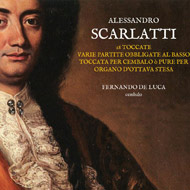
- Title: Primo tono Preludio. Presto, Adagio - Presto, Fuga, Adagio - Presto, Partite [sulla Follia di Spagna]
- Released at Salla del Cembalo der caro Sassone https://www.saladelcembalo.org/archivio/a2016_18.htm
- Duration: 19'20"
- Recording date: Partite (2015 Dec 19-21) Toccata d'ottava stesa (2016 Jan 28) in Cagliari
- Instrument: Flemish harpsichord built by F. Granziera (1993) after a Ruckers-Taskin model (Taskin 1780); Pitch A = 415Hz.
- Lucsaité-Mrázková, Giedré 'Italien Clavier
of the 17th and 18th Centuries'

- Title: Toccata per cembalo (1723)
- Released 1994 by ARTA Classic Records compact disc F10053-2
- Duration: 19'41"
- Recording date and place unknown
- Instrument: Double manual Flemish harpsichord after Ruckers 1627 (built in 1994)
- Marcinanti, Andrea and Francesco Tasini
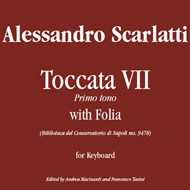
- Title: Toccata VII, primo tono with Folía
- Published January 2006 by UT ORPHEUS EDIZIONI, HS 160
- Pages 40
- Size 230x310 mm
- Marcon, Andrea (harpsichord) 'Alessandro Scarlatti, works for organ
and harpsichord'
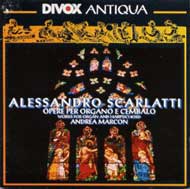
Andrea Marcon plays A. Scarlatti 's complete Ottava stesa including the Folia starting at 13'05"
Duration: 24'03" direct link to YouTube
© 1994 by Andrea Marcon- Title: Toccata per cembalo d'ottava stesa
- Released 1994 by Divox Antiqua compact disc CDX-79403
- Duration: variations 13'05", in total 23'50"
- Recording date: April 3-5, 1991 in the Chiesa San Giacomo, Polcenigo (Friuli), Italy
- Márquez Chulilla, Silvia (organ)
- Title: 'Variacions sobre La folia' per a orgue
- Broadcasted by Catalunya Musica December 3, 2012 for Una selecció dels millors enregistraments de la nostra fonoteca. Presentació d'Ignasi Pinyol. 32è CICLE ELS ORGUES DE CATA-LUNYA
- Duration: unknown
- Recording date: July 21, 2012 Catalunya Música. Parròquia de Sant Bartomeu i Santa Tecla. Sitges, Spain
- Márquez Chulilla, Silvia (harpsichord)
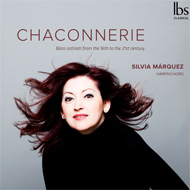
In the slipcase is written:The Naeapolitan Alessandro Scarlatti (1660-1725) enjoyed great fame as a composer of operas and vocal works. Nevertheless, perhaps influenced by Corelli's success and later by Vivaldi's Op. 1 (1705) he composed, in 1710, a cycle of thirty elaborated variations on the folia, pieces that are brilliant, lively and virtuosic.
- Title: 'Folia' (Primo e Secundo Libro di Toccate del Sig. Cavagliere), Naples 1723
- Released 2018 by Ibs Classical IBS52018
- Duration: 6'49"
- Recording date: July 30-31 and October 13-14 2017 in Auditorio Manuel de Falla, Granada Spain
- Martin, Béatrice (harpsichord) 'Alessandro Scarlatti, Totus Amore'
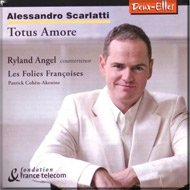
- Title: Variations on "La Follia" for keyboard
- Released 2006 by Deux-Elles compact disc B000FVX71S
- Duration: 7'28"
- Recording date: June 2003 in Douai Abbey, Berkshire, England
- Norell, Judith (harpsichord) 'Scarlatti, A. & D. Harpsichord Sonatas,
Partita & Toccata'
- Title: La Folia: 26 variations and theme
- Released 1978 by Sine Qua Non LP SA 2018
- Pol, Wijnand van de (organ) 'Antichi Organi Italiani'
Wynand van de Pol plays Toccata del primo tono including Follia
Duration: 22'44", Follia starting at 14'42" direct link to YouTube
© 1971 by Wynand van de Pol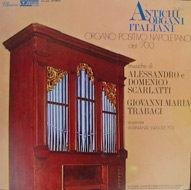
 In the documentation is written about the organ:
The instrument used for this recording is an antique Neapolitan positive organ of the second half of the Settecento. It has, therefore, all the characteristics of the Neapolitan school: a narrow diameter of the pipes, the almost complete absence of tongues, low-pressured bellows. The result is a simultaneously sweet and crystalline sound. Outstanding is the rather accentuated and unique anticipatory statement of the pipes preceding the actual sound, which confers a clarity and polyphonic texture to the notes. The keyboard is disposed as follows: Principal 8', Octave 4', XV 2', XIX 1'1/3, Flauto 4' Vox Humana 8' soprani. The author of this precious instrument remains anonymous, but the tachnique and tone quality are closely related to that of Dominicus Antonius Rossi, organ builder for the Royal Chapel from 1761 to 1789.
The organ was restored in 1969 by Bartolomeo Formentelli, one of Italy's most outstanding organ builders and the only one working on a completely artisan level. Restored according to strict historical criteria, it is one of the few existing positive organs able to recreate the true essence of the music which was written for it.- Title: Toccata del primo tono: Preludio, Adagio -Presto, Fuga, Adagio cantabile ed appoggiato - Follia (Partite sull'aria della ...)
- Released 1971 by Vendetta Records LP VST 6036
- Duration: 10'36" (Adagio cantabile ed appogiato - Follia)
- Recording date: Registrazione stereofonica effecttuata nel Giugno 1971
- The Purcell Quartet (harpsichord solo Robert Woolley) 'Alessandro Scarlatti, La Folia'
Robert Woolley plays A. Scarlatti's harpsichord variations on "La Folia as part of the Ottava stesa
Duration: 13'12" direct link to YouTube
© 1989 by Robert Woolley- Title: Folia from Toccata No. 7 (Primo tono) from the Primo e Secundo Libro di Toccate
- Released 1989 by Hyperion compact disc CDA66254
- Duration: 13'04"
- Recording date: April 29/30, 1987
- The Purcell Quartet (harpsichord solo Robert Woolley) 'La Folia,
variations on a theme'
 This cd assembles 'La Folia'-inspired works by six composers, starting
with the original Corelli Sonata and ending with Geminiani's orchestral
arrangement of it. The C.P.E. Bach and A. Scarlatti works are for solo
keyboard. The six pieces are all taken from a series of earlier Hyperion
cd's individually devoted to the respective composers.
Duration of the six folias (incl. Marais, Vivaldi) 68'22"
This cd assembles 'La Folia'-inspired works by six composers, starting
with the original Corelli Sonata and ending with Geminiani's orchestral
arrangement of it. The C.P.E. Bach and A. Scarlatti works are for solo
keyboard. The six pieces are all taken from a series of earlier Hyperion
cd's individually devoted to the respective composers.
Duration of the six folias (incl. Marais, Vivaldi) 68'22"
- Title: Folia from Toccata No. 7 (Primo tono) from the Primo e Secundo Libro di Toccate
- Released 1998 by Hyperion compact disc CDA67035
- Duration: 13'04"
- Recording date: April 29/30, 1987
- Raad, Nico de 'Van Hagerbeer organ, before and after the restauration'
- Title: Folia in d
- Released by TMD compact disc TMD 991101
- Duration: 1'46"
- recording date: September 1999 at the restaured Van Hagerbeer organ in the Pieterskerk, Leiden, The Netherlands (although in the container is mentioned that it was recorded at Chapel Studio Tilburg, The Netherlands which will be related to the mixing)
- Radulescu, Michael edited the edition 'Toccata nel primo tono' for organ
- Title: Preludio, Fuga , Partite sull'aria della Follia
- Published 1969 by Paideia, Brescia
- Score 31 p. 24 x 24 cm
- Series Biblioteca classica dell'organista, v. 1
- Sgrizzi, Luciano (harpsichord) 'Meister italienischer Cembalomusik des
17. und 18. Jahrhunderts' (Orbis) and originally 'Antologia della musica clavicembalistica italiana del secolo XVII' (Cycnus)
Lothar Hoffman-Erbrecht wrote for the cover of the LP (Orbis release):
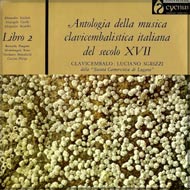
Das bedeutendste Cembalowerk Alessandro Scarlattis sind aber seine 'Variazioni sulla Follia di Spagna', Variationen über die aus Spanien stammende 'Follia'. Die Follia war ein Tanz im Dreiertakt mit dem getragenen Charakter einer Sarabande; sie bestand aus einem achttaktigen Modell, das beim Tanz nach Bedarf wiederholt und variiert wurde. Bald in Spanien, sondern in Italien, wo die Follia (eigentlich = Narrheit, Laune) bald eines der beliebtesten Themen für Variationen wurde. Das bekannteste Werk dieser Art schrieb Arcangelo Corelli in seiner 12. Violinsonate, die als 'Folies d'Espagne' noch heute auf den Programmen der Grossten Geiger steht. Alessando Scarlatti aber übertrifft ihn noch an Zahl und Vielfalt der Variationen. Nach 25 Variationen, in denen der Bau und die Harmonik der acht Takte nur wenig verändert werden, besliesst die Wiederholung des Themas ein Werk, in dem wirklich alle Register der Komposition gezogen werden; Das thema wird melodisch aufgelöst, rhythmisch abgewandelt und im Charakter vielfältig verändert. Es ist das grösste und bedeutendste Variationswerk für Cembalo, das vor Bachs 'Goldberg-Variationen' geschrieben wurde, und es ist so recht geeignet, die universelle Begabung Alessandro Scarlattis ins Licht zu stellen
- Title: Variazioni sulla Follia di Spagna
- Released without indication of the year of release by Orbis LP 73987 originally released by Cycnus 60 vinyl CS 515
- Duration: 7'58"
- Recording date: not indicated at all in the Orbis release but mentioned as December 1-3, 1962 in Lugano in the Cycnus release
- More about the oeuvre and life of this harpsichord player at http://jsebestyen.org/sgrizzi/
- Sgrizzi, Luciano (harpsichord) 'Cinq Toccatas'
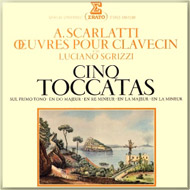
- Title: Variazioni sulla Follia di Spagna
- Released by Erato vinyl ERA 9089
- Duration: 7'43" (19'26" the entire toccata)
- Recording date: December 21-22, 1972 in Paris, France
- More about the oeuvre and life of this harpsichord player at http://jsebestyen.org/sgrizzi/
- Tasini, Francesco (harpsichord) 'Alessandro Scarlatti, Opera omnia per tastiera Vol. 1'
Francesco Tasini (in a translation by Priscilla Worsley) wrote for the slipcase:To conclude, we would emphasise the grandeur of the structure of 'Toccata VII' of the 'Primo tono' (Naples, 1723) that concludes the CD, a Toccata that, in the extended version (Preludio [Presto], Adaggio [Cantabile, è appoggiato], Presto, Fuga [Presto], Adagio, Folia [29 Partite]), assumes something of the atmosphere of a 'Sonata da Chiesa'
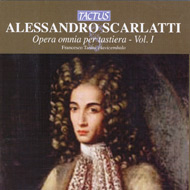
- Title: Toccata VII, Primo tono. Toccata per Cembalo dóttava stesa, Napoli, 1723 (Preludio, Adagio, Presto, Fuga, Adagio, Follia): Napoli, Manuscript 9478
- Released 2007 by Tactus compact disc TC 661911
- Duration: 9'31" (22'36" the entire toccata)
- Recording date: August 17, 2005 in Ferrara, Italy
- Harpsichord: Italian anonymous 18th century (Ferrara) rebuilt by Roberto Mattiazzo (Bologna) in 2001
- Weimann, Alexander (organ) 'Alessandro Scarlatti, Complete keyboard works, Volume 2'
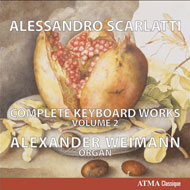 Alexander Weimann wrote for the slipcase (translated by Louis Bouchard):
Just as in the famous model of the "Toccata d'ottava stesa' folowed by the notorious Follia variations, the sequence of movements here is clearly recorded in the sources. The beginning, a rather convention.and predictable device, leads to a short connecting piece which, with each of its chord changes, defies all harmonic presumptions. The 22 variations on the ubiquitous Follia motif, more widely-known siblings (recorded in volume I). Here the focus is not on the melodic and harmonic daring, but rather on changing tone colour, movement, and the pace
- Title: Toccata, Arpeggio, Allegro, Arpeggio, Follia in D minor
- Released 2010 by Atma Classique 2 -cd-box ACD2 2528
- Duration: 12'41"
- Recording date: April 25, 26 and 27, 2007 in Ëglise Très-Saint-Rédempteur, Montréal, Canada
- Chancel organ by Wilhelm, Opus 129, 1993, 2 manuals and pedal. 15 stops, 15 ranks 752 pipes mechanical key and stop action
- Weimann, Alexander (harpsichord) 'Alessandro Scarlatti: Toccatas, complete keyboard works, volume 1'
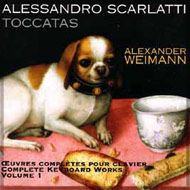 Alexander Weimann wrote for the slipcase (translated by Louis Bouchard):
The 29 variations of this composition on the famous ostinato model, well loved by many composers, take the theme harmonically, rhythmically, tachnically, and emotionally to its limits. Scarlatti explores new keyboard possibilities (in Variation 17 to 19) and opens up the tonal infexibility with abrupt acciaccature (in variation 24). The piece builds up up tension over the last five variations and comes to a sudden and rough halt descending abruptly and, to our unbelieving ashtonishment, ending in an open question without returning to the original key.
- Title: Follia en ré mineur
- Released 2005 by Atma Classique compact disc 7 22056 23212
- Duration: 7'27"
- Recording date: October 14-17, 2003 in the Église Saint-Alphonse-Rodriguez, Saint-Alphonse, Québec, Canada
- Harpsichord built by David Werbeloff, Boston 2002 after a harpsichord by a late-17th-century anonymous Italian maker attributed to Giacomo Ridolfi, Musical Instrument Museum, Berlin, Germany
- Weimann, Alexander (harpsichord) as part of the ensemble 'Tragicomedia',
' Capritio, instrumental music from 17th century in Italy' by Tragicomedia
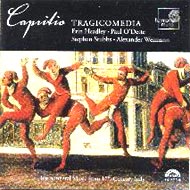
- Title: Variazioni sulla 'Follia di Spagna' A. Scarlatti
- Released 2001 by Harmonia Mundi USA compact disc 907294
- Duration: 7'00"
- Recording date: June 2000 at Skywalker Sound, Nicasio, CA USA
- Weimann, Alexander (harpsichord) as part of the ensemble 'Tragicomedia',
'Concert at Bremen'
- Title: Variazioni sulla 'Follia di Spagna' A. Scarlatti
- Concert by Tragicomedia as part of their program 'Capritio'
- Concert as part of the Festival 'Pro Musica Antiqua'
- Broadcasted by the dutch radio NPS in a coproduction with Radio Bremen September 05, 2001
- Duration: 6'32"
- Recording date: May 06, 2001 at the Kirche Unser Lieben Frauen, Bremen Germany
The original manuscript conserved in Turino in Biblioteca Nazionale di Torino, Fondo Foà-Giordano ms. 394
- Marcinanti, Andrea and Francesco Tasini
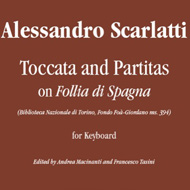
- Title: Toccata and Partitas on “Follia di Spagna” (Biblioteca Nazionale di Torino, Fondo Foà-Giordano ms. 394) for Keyboard
- Published January 2006 by UT ORPHEUS EDIZIONI, HS 162
- Pages 20
- Size 230x310 mm
- Scarlatti, Alessandro (editor unknown)
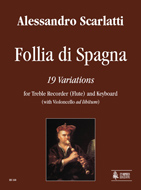
- Title: Follia di Spagna, 19 Variations for Treble Recorder (Flute) and Keyboard (with Violoncello ad libitum). There is an extra recorder melody added to the existing keyboard version.
- Published 2007 by UT ORPHEUS EDIZIONI, HS168
- Pages 20 + part 16
- Size 230x310 mm
- Steger, Maurice (direction, recorder); Fiorenza de Donatis, Andrea Rognoni, Anaïs Chen (violins), Stefano Marcocchi (viola), Mauro Valli (cello & violoncello piccolo], Vanni Moretto (double bass), Brigitte Gasser (violetta, viola da gamba & lirone), Naoki Kitaya (harpsichord & organ), Daniele Caminiti (theorbo, baroque guitar & archlute), Margit Übellacker (psalterium) " Una follia di Napoli 1725"
- Title: A. Scarlatti: Improvisation upon the Partite 'Follia di Spagna'
- Released by Harmonia Mundi compact disc HMC902135
- Duration: 11'12"
- recording date: November 21-26, 2011 in the Reformed church of Arlesheim, Switzerland
- Tasini, Francesco 'Alessandro Scarlatti: Opera omnia per tastiera, Vol. 6'
- Title: Follia in D Minor
- Released 2018 by Tactus TC661916
- Duration 16'22"
- Italian harpsichord by anonymous Ferrara, 18th Century
- Recording date October 2015 at studio G. Monari Massa Finalese, Modena, Italy
- Silvestri, Franz (organ solo)
Franz Silvestri live organ
Duration: 8'59" direct link to YouTube
© 2013 by Franz Silvestri- Title: Partite (Sulla Follia di Spagna)
- Published October 2013 by Franz Silverstri for YouTube
- Duration: 8'59"
- Recording date: October 2013 in Italy
|
The sheet music as published by Hofmeister |
Information about Schaffner is difficult to find. I have only been able to find a short bio of him in Fetis' Biographie universelle des musiciens et bibliographie générale de la musique: Volume 8, pg. 71.
Schaffner (Nicolas-albert), born in Silesia in 1790, learned to play several instruments in his youth, particularly the violin and clarinet, on which he acquired a certain degree of skill. He lived in Breslau [now Wroclaw, Poland] for some time, then traveled to Germany and arrived in Paris in 1815, where he was appointed director of music for a regiment of the royal guard; but he gave up this job at the beginning of 1817 to succeed Alexandre Piccini in his position as conductor of the Porte - Saint Martin, Rouen theater . He wrote stage music in the form of melodramas and pantomimes like The Prince and the Private; Daniel, or the Pit of Lions; Azendaï; Cabane of Monlainard; Marshal Villars; the Outlaws and the Bride; Little Red Riding Hood; The Invisible Brothers, etc. The reasons that made him give up his position as the director of the orchestra of the Rouen theater in 1821 [is unknown], but he [nonetheless continued] performing his functions until 1834. The following year he [finally] left that position, but it is unclear what [caused him to do this]. A painstaking artist, Schaffner published many [pieces] of harmony music for wind instruments, composed or arranged by him, and pieces for various instruments".
No date of Schaffner's death is given by Fetis when he was writing his Biographie quoted above, which was published in 1844. Regardless, Schaffner's La Folie must have been composed well before the publication date of Frederic Hofmeister's score in 1872, although I can not find any references to the composition which might indicate the year in which it was written.
It is interesting that Schaffner's La Folie does not start with a "theme," i.e., using the Folia in its traditional format (like, say, Marin Marais did in his version). The concept of "variations before (or without) a theme" otherwise belongs to stylistic developments more common in the the 21st century. It is a virtuoso piece, displaying a highly advanced violin technique, demanding skills close to those introduced by Paganini. Paganini's first public performances as a soloist began in 1810 and he eventually visited Germany and France 1829-31, where Schaffner was located according to Fetis.
The question is whether Schaffner was ever able to hear one of Paganini's performances for himself; Paganini was notoriously careful about letting his written music out of his own sight, because of the lack of copyright protection in his day. He only allowed some of his works to be published, like the 24 Caprices, which were published in 1819.
On one hand, Schaffner's variations share traits with Paganini's Caprices, like fast arpeggios from the lowest to the highest register of the violin and melodic passages accompanied by simultaneous double stopping in faster note values, playing in the extreme high register of the violin and flying spiccato. On the other hand, Schaffner does not use extensive double-stopping in octaves and tenths - although one variation requires the player to stretch to play a tenth double stop - nor does he make extensive use of harmonics.
Thus most of Schaffner's stylistic traits could have come from composers like Locatelli and the virtuosos of the French school of violin playing who developed the use of flageolets as well as other violinist-composers of the second half of the 18th century, who had already introduced most of the elements of violin technique that are contained in Schaffner's La Folie. A dating Schaffner's piece is therefore not easy, but considering his year of birth and the style of the pieces, anywhere between 1810 and 1830 or somewhat later may be possible. Ultimately, it will require on either finding the manuscript - if it still exists - and determining its date through water mark analysis, or finding better documentation about Schaffner's life and the source of the edition published by Frederic Hofmeister in Leipzig in 1872.
- Hofmeister, Frederic publisher of the music
- Title: La Folie. Thirty Caprices for Violin, Op.26
- Published 1872 in Leipzig
- Number of pages: 13 including title page in A4 format.
- No recordings or other acoustical examples are found so far
- Baak Griffioen, Ruth van (recorder and voice flute), Amano, Toshi (baroque violin), Sarah Glosson (viola da gamba and baroque cello),
Marshall, Thomas (harpsichord) 'Baroque on Fire, 17th- and 18th- century Italian and German chamber music'
 '
' - Introduction to La Folia (Tom) and Variations on La Folia
- Released 2000 by GCB Records
- Duration Introduction 2'33", La Folia 5'19"
- Recording date: live concert August 29, 2000 Bruton Parish Church, Duke of Gloucester St. Williamsburg Virginia
- Lasocki, David editor of score. Figured bass realized for keyboard instrument;
includes part for violoncello, viola da gamba, or bassoon.
- parts: 1 Adagio, 2 Grave, 3 Vivace, 4 Allegro,
- Published 1979 by Nova Music, London
- Score 11 p. and 3 parts, 31 cm
- Publisher No. N.M. 107
- Legene, Eva (recorder), Krainis, Bernard (recorder), Scott, Christina
(harpsichord)
- Title: Variations on La Follia for two recorders and basso continuo, op. 6 no. 6
- Recorded by the Indiana University, School of Music in Bloomington
- Sound reel tape 1987-1988 no. 25
- Duration: 4'42"
- Recording date: July 2, 1987
Detected by Bret Werb, this rather unknown composition. The Folia theme is quoted in the opening and closing of the Gigue movement. Quoting the Folia opening twice ending in the dominant septiem,. Closing the gigue in the tonica to make it full circle.
- Elbipolis Barockorchester Hamburg
- Title: Gigue (1713)
- Released 2012 by Challengecompact disc ordernumber 72531
- Duration 1'43"
- Recording date: unknown
The use and construction of the Folia in this composition is somewhat similar to the one by Nicolas Bacri with the fragmentations, the evolution and the revealing of the theme itself towards the end.
Kees Schoonenbeek wrote about his composition:
From the very start of the composition there is the reflection of the Folia-theme because the left hand of the piano plays an inversion of the theme, harmonizing with another inversion of the oboe-part, which results in a somewhat alienated effect. Some fragments of the Folia theme emerge as the composition is unfolding. In the conclusion of the composition the Folia-theme is finally stated.
- Schoonenbeek, Kees
- Published 1979 by Donemus, Amsterdam
- Duration: ca. 06'30"
In the second part of this composition the Folia-theme itself is introduced.
- Schoonenbeek, Kees
- Published 1989 by Haske Publication, Heerenveen, The Netherlands
 |
| © Stichting Het Joop Schoutenhuis
|
This composition with theme (Andante) and 9 variations (I, II Allegretto, III Allegro, IV, V Scherzando, VI Allegretto, VII Adagio, Fughetta, Largo) is kept rather close to the Folia chord progression and melody line in the traditional tonal style.
Joop Schouten frequently played this composition during concerts in the close intimacy of his private residence.
Although the composition isn't recorded yet (February 2005) for any official release (which is planned within a year by Stichting Het Joop Schoutenhuis), it seems worth to give visitors an impression of the composition. The only tool available for me was to turn it into a midi-file, lacking dynamics, proper voicing, use of stops, failing the elementary acoustic sound of an organ etc.
All praises to Johan Vos and Aart de Kort, two organ players who gave valuable advice especially about the tempi of the parts. I realize it must have been horrible for them to hear this composition in the limited midi-format.
- Stichting Het Joop Schoutenhuis
- Published (year unknown) in 'Joop Schouten, Orgelwerken, deel II' (Works for organ, part II) by Het Joop Schoutenhuis, Prinses Annalaan 232, 2263 XS Leidschendam, The Netherlands
- 9 pages, size 21 x 29 cm
- Duration: ca. 07'30"
- Balyon, Piet (organ)
A live performance by Piet Balyon in the Agneskerk, The Hague Harderwijk (NL)
Duration: 9'00" direct link to YouTube
© 2010 by Wim & Piet Balyon- Published at YouTube by wimbalijon1925, 1 December 2010
- Duration: ca. 09'00"
- Recorded live at the Agneskerk, Den Hague, The Netherlands
- Kort, Aart de (organ)
A live performance by Aart de Kort in the Grote Kerk in Harderwijk (NL)
Duration: 9'48" direct link to YouTube
© 2012 by Aart de Kort and René Citeur
- Recorded during a live performance by René Citeur
- Duration: 09'48"
- Recorded live July 26, 2012 at the Grote Kerk in Harderwijk (Bätz organ), The Netherlands
|
|
Duration: 7'31", 09 kB. |
In the slipcase was written about the piece:
.Der Name "Folia" taucht schon um 1500 in der portugiesischen Dichtung und in Hofchroniken als Bezeichnung eines Tanzes
auf. Da er als laut, wild und verrückt beschrieben wird, gehörte die Folia als Tanz in die Gruppe der Fruchtbarkeitszeremonien. -
Oie Spanier haben den Tanz übernommen.
Die Folies d'Espagne wurden von den Spaniern nach sarabandenähnlichen
Dreivierteltaktmelodien sehr leidenschaftlich getanzt. Die barocke Folie d'Espagne hat ihren Charakter - wie
verchiedene andere Tänze auch - völlig verändcrt , als sie am Hofe Ludwigs XIV gesellschaftsfáhig wurde. Die Melodie und das
harmonische Gefúge wurden bereits 1553 von Diego Ortiz beschrieben. Ähnlich wie die Chaconne und die Passacaglia ist die
Folia nach dem Variationsprinzip aufgebaut.
Durch die Musikgeschichte zieht sich die Folia wie ein roter
Faden. Lully 1672, Gaspar Sanz 1674,.John Playford 1685,
Arcangclo Corelli 1700, Marin Marais 1701, J. S. Bach 1722 in
der "Bauernkantate" und G. F. IIändel etwa zeitgleich in der
"Ode to St. Cecilia'" seien hier als Beispiele angefügt. Die hier auf
der Theorbe eingespielten Variationen von La Folia sind im Stil
der Zeit von Thomas Schulz improvisiert.
Die Choreographie stammt von Raoul Auger Feuillet: "Chorégraphie ou I'art de décrire la danse par caractères, figures et signcs demonstratifs", Paris 1700. Dem Thema der ersten Tanzvariation ist einc originale Kastagnettenstimme hinzugefügt. Ria Schneider (Köln) hat zu den Variationen 2 -6 weitere
Kastagnettenstimmen geschrieben (Kastagnetten-Spielbuch
Ria Schneider, Musikvcrlag Zimmermann 1991). Im Endeffekt
lasscn sich dic Folia-Variationen sowohl (nach Feuillet) tanzen
oder auch mit den Kastagnetten "klappern".. Die höchstc Kunst
ist jedoch, beides miteinander zu kombinieren.
- Ensemble Buon tempo
"Höfische Lustbarkeiten, Gesellschaftstänze aus Renaissance, Barock, Rokoko & Biedermeier
- Title: La Folie d'Espagne
- Released 1998 by Verlag der Spielleute compact disc CD9803
- Duration: Einleitung (reference for the dancing lady) 0'35", Thema 0'38", Var 1 Andante 0'29", Var 2 Très grave 0'41", Var 3 Andante 0'31", Var 4 Modarato 0'25", Var 5 Grave 0'51"
- Recording date: October 1998 in Berlin, Germany
- Sebestyén, János (organ)
 Robert Tifft wrote about this Folia-improvisation:
János Sebestyén has performed throughout the world as organist, harpsichordist and pianist and is a veteran broadcaster for the Hungarian radio and television. He is one of the few performers today that incorporates improvisations into nearly all of his recitals. His free improvisation on the Folia theme was the final selection of a program performed on March 9, 1993 at the National Auditorium in Madrid, Spain. The improvisation begins with the unadorned theme quietly stated. A series of variations ensue, each one becoming more elaborate and gaining in intensity. The first variations are simple embelishments of the Folia melody with one incorporating aspects of a Spanish fandango. The keyboard figuration becomes more elaborate, eventually leading to the theme boldly stated by the vibrant Spanish reeds. An almost hymn-like statement of the theme follows, leading to a quiet passage of introspective character. The Folia melody gradually reappears in its hymn-like guise, modulating to a major key, for a triumphant conclusion utilizing the full organ.
You can find more background information and acoustical samples (mp3-format) at the excellent webpage 'J ános Sebestyén - organist, harpsichordist, pianist' including a complete discography: http://www.jsebestyen.org
- Broadcasted 1993 by the Spanish Radio RNE
- Duration: 12'28" (without the applause)
- Recording date: March 9, 1993 at the National Auditorium in Madrid, Spain
|
|
Duration: 12'42", 11.91 MB. (128KB/s, 44100 Hz) |
 |
István Lantos and János Sebestyén |
- Sebestyén, János (piano) and Lantos, István (piano)
A sparkling improvisation built around the Folia-theme which evolves towards a derivation of the 'folia'-progression of Händel (Sarabande from harpsichordsuite nr. 11 in D minor, Book II, 1727) before ending in the folia-theme in a brilliant style.- Recorded live 2000
- Duration: 5'46"
- Recording date: May 31, 2000 at the Sala de Columnas del Círculo de Bellas Artes, Madrid
|
|
Duration: 5'46", 5.29 MB. (128KB/s, 44100 Hz) |
| Opening of Variations on La Folia in D minor page 13 Ms Selosse |
|---|
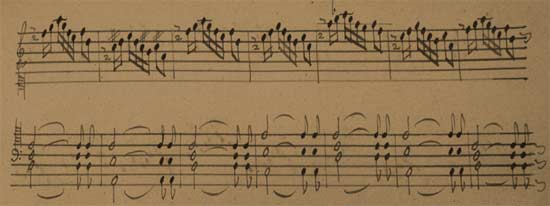 |
Terence Charlston wrote in the slipcase about the Folies d'Espagne:
The monumental set of variations on the "La Folia" ground which open dthe collection deploy a rich panoplyof textures and technical devices. They run to 24 variations including the opening statement and the theme is written as mainly equal crotchets throughout. The set is very similar to its concordance in the Hogwood MS, although Selosse is five variations longer, and only 14 sections are shared between the two sources. The two sources also disagree on certain small details of the text. Of the 10 variations unique to Selosse, sections 15 and 16 are particularly expressive, and the order and reworking of the last third of the work arguably strengthens its conclusion.
Johan van Veen wrote about this recording:
This exciting and historically important new CD, entitled ‘La Chasse Royale’ presents a newly discovered manuscript of music by Antoine Selosse. Although it seems possible that Antoine Selosse (the Jesuit musician Antonio Mason alias Selosse, 1621-87, who was active at the English Jesuit College of Saint Omer in the 1680s) is the ‘Selos’ to whom the contents of the manuscript were attributed in the first flyleaf inscription, various factors mitigate against his authorship of the whole collection.
The repertoire chosen for inclusion in Selosse’s remarkable book covers a broad spectrum of the genres popular in seventeenth century Europe and reveals a wide range of national influences and styles. It consists of mainly dance pieces (often with variations of their own) and these are grouped by key. Few pieces have a specific title and no composers are named but the authorship of only one piece can be stated with confidence: Bull’s popular The King’s Hunt 3 and the suites in G major (13-14) and D major (16-19) are strikingly similar, on stylistic grounds, to works by John Roberts.
Most compositions in the manuscript are anonymous; only John Bull as the composer of The King's Hunt is known with certainty. It is possible that some pieces may have been written by Antoine Selosse himself, in particular the liturgical works. These were clearly intended for the organ, but otherwise the choice of the keyboard is left to the performer. That will always be a matter of debate.
- Charlston, Terence (harpsichord) 'La Chasse Royale'
- Title: Variations on La Folia in D minor
- Originally by anonymous Ms. Selosse
- Released 2010 by Deux-Elles 2-cdbox ordernumber DXL1143
- Duration: 10'59"
- Recording date:June 14 and September 3, 2009 in St Botolph's Aldgate & Holy Trinity Church, Weston, Hit, England
Valentín Serrano wrote about his composition in December 2004:
Although I'm not a composer, I like the Folía theme so much that I tried to write a little composition about the theme a year ago.
Just for fun and to understand the music better. My friend Ale Delgado, who is a student at the conservatory pointed me
in the right direction and gave me some general instructions. Still it took me great effort to master the composition
the way it got its final shape.
Well, here you are. Regard it as a present for the work with the Folía pages, which is one of my favourites pages.
|
Duration: 1'38", 8 kB. |
- Serrano, Valentín
- Recorded with the software Sibelius
- Duration: 1'38"
- Recording date: 2003 at the Spanish city of Cuenca
This composition is clearly inspired by the music of the Baroque era. In every variation the theme is hard to miss and it takes you on a musical journey to the 'Beethoven' variations (6'10") to finish off in a typical symphonic manner.
Glen Shannon wrote about his composition:
It is a 14-variation piece composed for the American Recorder Orchestra of the West (AROW), a new group which began in May 2000 in northern California. The twelve parts consist of one sopranino recorder, 2 sopranos (descants), three altos (trebles), three tenors, one bass in F, one Great Bass in C, and one Contrabass in F. A Recorder Orchestra is an expanded recorder ensemble with more of the unusual large and small sizes for added tone colors.
|
|
Duration: 7'41", 58 kB. |
- Shannon, Glen
- Published by Screaming Mary Music 2001
- Score 48 p. (including cover) and 12 parts of 3 p., 29 cm
- The score can be browsed at http://www.sibeliusmusic.com/cgi-bin/showscore.pl?scoreid=3829 You need a browser plug-in called Scorch, but they provide a link to download it.
- Publisher No. SMM400
This quintet is a reduction of the recorder orchestra version for 12 instruments. Each player except the bass recorder player is assigned two instruments and must switch between them as the piece progresses.
Glen wrote about this version December 6, 2006:
Charles Fischer (Unicorn Music, http://www.buyrecorders.com) commissioned it and it was completed in 2005.
He believed in the quality of the music and wanted a version that was much more portable, noting that 5 players with Bass being the largest size is much more
obtainable than 12 players and super-size recorders.
The recording is indeed a live performance in concert, recorded Aug. 15, 2006 at Arlington Community Church in Kensington, California.
I'm glad you like the quality of the recording; the mics could have been closer. A friend of mine fixed up the original for me. My fellow
players were excellent and their playing added so much more to the sound than I could have hoped for.
Each part switches between two recorders of adjacent size in order to cover everything in the original 12-part version, from smallest to largest:
Si/S means Sopranino/Soprano (Soprano = Descant in the UK)
S/A = Soprano/Alto (Alto = Treble in the UK)
A/T = Alto/Tenor
T/B = Tenor/Bass
B = Bass (this part does not change instruments)
S and T are one octave apart in the key of C (meaning lowest note, all fingers down, is C); Si, A and B are octaves apart in the key of F.
Duration: 8'44" direct link to YouTube
|
|
|
Duration: 8'37", 8.29 MB. (128KB/s, 44100 Hz) |
- Shannon, Glen (recorders Si/S) Bauer, Annette (recorders S/A) Molinari, Rebecca (recorders A/T) McMahon, Mark
(recorders T/B) Feldon, Frances (recorder B)
- Published by Screaming Mary Music SMM140 $15.00
- Recording date of live performance: Aug. 15, 2006 at Arlington Community Church in Kensington, California
This work was commissioned by the Bavarian Radio Symphony Orchestra and was premiered at te same year by that orchestra under David Shallon in Munich in the framework of their Musica Viva series of concerts.
|
Duration: 1'11", 1124 kB.( 128kB/s, 44100Hz) |
|
Duration: 1'48", 1698 kB.( 128kB/s, 44100Hz) |
The work is written for a large symphony orchestra and is
published by the Israeli Music Institute (IMI) but can be obtained shortly
by Peters Edition, Frankfurt.
Unfortunately, the record issued in Israel of this and other works of mine
conducted by Gary Bertini is no more on the market and there is no CD yet.
However the recording exists in the Bavarian radio and the Israeli broadcasting
authorities.
Noam Sheriff's La Folia variations consists of a prologue, eight variations
and an epilogue. The theme itself makes its appearance only after the fourth
variation. The first half is composed rather of strictly conceived variations
which unfold in the direction of the theme while the second half is more
like a 'Folia', a madness, so to speak.
- The Düsseldorf Symphoniker, conductor Noam Sheriff 'Noam Sheriff, "La Follia" Variations, Concerto for Violoncello and Orchestra, Akeda, Wenn das Pendel der Liebe schwingt'
- Released 2002 by Col Legno compact disc 20065. More information at the page http://www.col-legno.de
- Duration: 18'58"
- Recording date: June 25 till July 2nd, 2000 in Tonhalle Düsseldorf, Germany
- The Jerusalem Symphony Orchestra, conductor Gary Bertini 'Noam Sheriff: La Folia Variations for Orchestra
Akdamoth, Music for woodwinds, trombone, piano & bass'
- Released 1985 by Jerusalem Records (manufactured in England by Nimbus) LP ATD 8601 DIGITAL (digitally remastered from analogue originals)
- Israel music anthology volume 9
- Duration: 17'55"
- Recording date not mentioned in the documentation
- Sheriff, Noam
- Published 1985 by the Tel-Aviv Israel Music Institute, Israel
- Also published in Hebrew
- Publisher No. IMI 6493
Noam Sheriff wrote for the slipcase:
1 had already planned to compose variations for orchestra
several years ago. This plan became a reality when, to my surprise, David
Shallon (a former pupil of mine) asked me to write just such a work for
a concert of the Munich "musica viva" which he was to conduct.
The "La Follia" Variations are in fact dedicated to him.
When I started the work, 1 didn't yet have a distinct idea on what theme
or motto actually to base the variations. That initial uncertainty was indeed
appropiate to the situation: variations in search of a theme. And the more
1 occupied myself with my musical sketches, the more it became clear to
me that 1 was really looking for something well-known, that was resting
forgotten and undetected in my memory. Only when the third variation had
already taken shape on paper 1 suddenly realized that this enigmatic, indistinct
theme was La Follia: that simple, beautiful melody, so familiar to every
music-lover.
But as soon as 1 asked myself the question, "Why precisely La Follia?",
1 could not find a satisfactory answer. It is somehow a mystery. Looking
closely at the melody itself, one cannot but wonder why it has been the
source of inspiration for so many compositions since the 16th century: from
Stefani's Folies d'Espagne (1622) to Frescobaldi, Lully, Corelli, Geminiani,
Bach and Cherubini, on to Liszt, Nielsen, Rachmaninov and several contemporary
composers like Henze. 1 was particularly happy to discover later that La
Follia's first emergence goes back to the year 1505 in a work by the Portuguese
poet and musician Gil Vincente. In this work, whose music is thought lost,
four biblical figures - Abraham, Moses, Solomon and Isaiah - are singing
a four-part Follia. My composition consists of a prologue, eight variations
and an epilogue. The theme itself makes its appearance only after the fourth
variation. In this respect, as welf as in others, this is a symmetric composition
throughout although I wish to emphasize that in this case "symmetry"
has manifold meanings. If I were, for instance, to explain more exactly
the balance between emotion and form, I would say that the first half is
composed rather of strictly conceived variations which unfold in the direction
of the theme while the second half is more like a Follia, a madness, so
to speak. Should I again ask myself the question, "Why indeed La Follia?",
1 can only try to give an answer by means of my music.
To all this, I would like to add the beautiful and poetical words by Gregorio
Paniagua: "All the composers in the whole world, who write their own
Follia, have hardly any clear idea of what they are doing. They are like
a tree which will ripen without worrying about its sap. Like the tree, they
absorb everything in the midst of the storms of spring, not being afraid
that another springtime would perhaps never come. And spring does arrive
and they are overcome by a mellow tiredness and they are patient without
worries and so calm, as though they were in the presence of eternity. This
way they are able to carry in themselves their Follia (their madness) and
their loneliness. They tolerate the pain that both these are causing them
and they succeed to lend beauty to the sounds of their lament" (quotation
taken from the liner notes to Paniagua's CD La Follia de la Spagna).
Sidera Noctis is Mauro Martello and Roberto Pusterla flutes, Mariagrazia Onesto keyboard,
Antonella Bersoli: viola da gamba The composition leans very much upon a summary of the scores by Vivaldi's, Corelli's and Bellinzani's Follia with more modern instruments.
La Follia |
- Sidera Noctis
- Released 2011 by Sidera Noctis in mp3-format
- Duration: 4'42"
- Recording date: unknown
 Folías was premiered with the New World Symphony with Alasdair Neale conducting
in Miami September 21st, 2002. Other performances were scheduled with the
Dallas Symphony, the Indianapolis Symphony, and the Bilbao Symphony in Spain.
Folías was premiered with the New World Symphony with Alasdair Neale conducting
in Miami September 21st, 2002. Other performances were scheduled with the
Dallas Symphony, the Indianapolis Symphony, and the Bilbao Symphony in Spain.
In one aspect this Folia is unique. It is written for a large orchestra and the guitar as a solo-instrument. The orchestral part is written for the large section of strings, percussion, woodwinds, two horns and two trumpets. As far as I know this is the only guitar concerto that uses the Folia-theme as the subject.
When you hear this piece for the first time it will sound very familiar because there are simply no surprises in the music. It all sounds suspiciously smoothly, predictable and lighthearted. The woodwinds are waking the listener up now and then when they copy some Rodrigo-idiom. The rest you all have heard before I am sure but in a different context. It is like an exercise to implant style figures of the classical guitar-orchestral idiom into the Folia-theme by someone who has listened a lot to the guitar concertos of Rodrigo.
The composition is divided into 11 sections with unequal duration and different techniques. The opening does not start right away with the Folia-theme as most folia-compositions do. In the opening the prominent guitar backed up by cautious strings is trying to find its way in a quasi improvisation but the winds (trumpets) firmly sets in the theme to put the guitar on track with some fast variations of the Folia-theme starting in bar 29. In every section and variation the Folia-theme is clearly stated and all techniques for the guitar pass along from tremolo to rasgueado and punteado but the most interesting part is the shifting from the minor to the major and back again to the minor key. I guess this music will find its way easily to waiting rooms of dentists. Roberto Sierra wrote about his composition:
Folías is the second guitar concerto I composed for Manuel Barrueco. Like its predecessor, Concierto Barroco, the newer work has strong Baroque influences. The melodic-harmonic theme known as 'La Folía was widely used in the Iberian Peninsula since the sixteenth century. Countless composers wrote variations on 'La Folía', among them Scarlatti, Carl Philipp Emmanuel Bach, Arcangelo Corelli, and Marin Marais. It was the work of Marais which served as point of departure and inspiration in my treatment of 'La Folía' theme; in fact, some of the variations in my piece have their roots in Marais' 'Les Folies d'Espagne' (1701). In terms of instrumental writing, the guitar yields itself as a perfect vehicle for the haunting theme. In 'Folías' I evoke both the world of the Baroque and that of our own time
Eladio Scharrón called it a masterwork, comparable with the best achievements of twentieth century composers like Rodrigo and Ohana.- Barrueco, Manuel (guitar) and Orquesta Sinfónica de Galicia conducted by Víctor Pablo Pérez
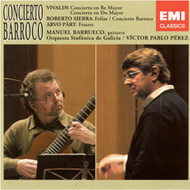
- Released 2005 by EMI compact disc ordernumber 5577862
- Duration: ca. 11 minutes
- Recording date: unknown
- Barrueco, Manuel (guitar) and the New World Symphony conducted by Neale,
Alasdair
- Duration: ca. 11 minutes
- Worldpremiere September 21, 2002 in Miami, USA and broadcasted simultaneously at Internet2
- Barrueco, Manuel (guitar) and the Dallas Symphony Orchestra conducted
by Cortese, Federico
Laurie Shulman wrote in an introduction for the Playbill by the Dallas Symphony Orchestra conducted by Federico Cortese for three performances with Manuel Barrueco:
(© Laurie Shulman, First North American Serial Rights Only, and used with permission)
The work that we hear this evening (Dallas, March 13, 14 and 15, 2003) has both an Iberian flair and a strong connection to the music of the past. Folias is one of those tunes, like Paganini's 24th Caprice, that has inspired many composers writing in different eras and certainly different musical styles. In the case of Folias, the roots extend back much farther than Paganini's unforgettable melody: to the fifteenth century. The term Folia, which is of Portuguese origin, is related to the Latin root for 'fool' or 'madness', and refers to a dance that was likely a court 'fool's dance'. The music that has inpired composers from the Baroque era to the modern day is a harmonic pattern related to two additional dances: the passamezzo antico and the romanesca. In the late seventeenth and eighteenth centuries, Alessandro Scarlatti, Marin Marais, Arcangelo Corelli and Johann Sebastian Bach were among the many composers who took this harmonic pattern as the basis for variations sets. In the pre-classical and classical eras Grétry and Cherubini adapted it. Franz Liszt followed in the romantic era with his Rapsodie espagnole. Twentieth-century iterations include Carl Nielsen's opera Maskarade and Rachmaninoff's Variations on a Theme by Corelli, Op. 42. Now Roberto Sierra, in the twenty-first century, has taken his bow to Folias as well.
- Duration: ca. 13 minutes
- Played in the Eugene McDermott Concert Hall, March 13, 14 and 15, 2003 in a program with Dvoráks Symphony No. 6 and Haydns Symphony No. 94.
- Sierra, Roberto (for Guitar & Orchestra - piano reduction)
- Published by Subito Music Number 1301864CK
- Score 36 pages Folio format
| Opening of one voice of La Folia, Neue Variationen nach Farinelli-Corelli |
© Gustav Bosse Verlag, 1969 Reproduced with permission |
|---|---|
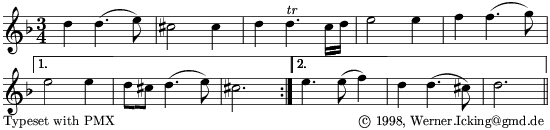 |
|
- Kula, Karl (edited the sheet music)
- Title: La Folia, Neue Variationen nach Farinelli-Corelli für 4 oder 8 Violinen
- Published 1969 by Gustav Bosse Verlag, Postfach 10 14 20 D-34014 Kassel
- Score 4 voices, 4 p. each, 31 cm
- Publisher No. Bosse Edition 332-22, ISMN M-2011-9599-5
- Libbert, Jürgen (arranged the music for two guitars)
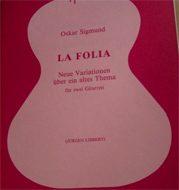
- Title: La Folia, Neue Variationen über ein altes Thema für zwei Gitarren (1973/1974)
- Published 1986 by Verlag Zimmermann
- Publisher No. ZM25520, ISMN M-010-25520-0
- Two identical parts of 10 pages each
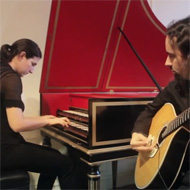
In the description of the YouTube publication was written:
This composition was created five days before they got married, and most of the variations are improvised. The variations start in a Renaissance style changing throughout the ages until it climaxes in a 21st century style.
Improvised Variations on "La Folía"
|
- Lucia Caruso (harpsichord) and Pedro H. da Silva (Potuguese guitar)
- Title: Improvised Variations on "La Folía"
- Published at YouTube 13 August 2012 by ManhattanCamerata
- Duration: 6'58"
- Recording date: not mentioned in the documentation
- More about Pedro da Silva and Lucia Caruso (Manhattan Camerata) at http://www.manhattancamerata.com/MANHATTAN_CAMERATA/Home.html
- No published music of La Follie di Spagna found.
- Published in Fétis, François-Joseph, Biographie universelle des musiciens…, tome 8, 2e édition, Paris, 1868, p.51
- Thanks to François-Emmanuel de Wasseige for detecting this item in literature
More about the composer Nicholas Van Slyck you can find at the website: http://vanslyckmusic.com/
Trudi Van Slyck wrote in an e-mail June 8, 2008:
As to the form, there is an introduction (not called such) ending in a thin double bar, then the statement of the theme.
The Allegro is next (really the first variation but not called that). Vivace is next (second variation), then Moderato which is the theme again in canon.
Ritmico is the name of the next section followed by Parlando, senza misura. Next is Allegro which leads into the last section with no new tempo name.
It functions as a coda and is the theme again in big chords with decorative scale figures between the phrases.
It is a sizable piece of twelve printed pages. I played the piece on the piano in a concert which I don't think was recorded and I have been told it is
played by a harpsichordist at McGill in Canada. Also I know it was played on the organ many times in Europe by David Pizarro in 1967-1970,
and also by some of his organ students.
Diferencias was composed in 1966 and edited in 1982 - probably for publication in 1984.
I have looked at the original 1966 manuscript of Diferencias and there really is some difference though the basic piece is the same.
In the early version the variations are numbered 1 - 6. In the printed edition several arpeggios have been added to the last variation.
Also there are places which have been moved down an octave and places where an octave passage has been expanded. I also have found
a few misprints in the printed edition. It seems the more I look the more I find.
The truth is that Irma recorded the printed (revised)edition with the added arpeggios. The original 1966 version was never recorded as far as I know.
It is not a major revision but notes are added.
- Rogell, Irma (harpsichord)
The complete diferencias as played by Irma Rogell
Duration: 7'50" direct link to YouTube
© 1982 by Trudi Van Slyck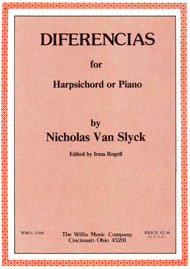
Duration: 0'48", 1.1 MB. (192KB/s, 44100 Hz)
Diferencia No. 2 as part of Diferencias, played by Irma Rogell
© 1982 Van Slyck, used with permission
Irma Rogell wrote as an introduction to the piece for the vinyl recording:Duration: 0'45", 1 MB. (192KB/s, 44100 Hz)
Diferencia No. 4 as part of Diferencias, played by Irma Rogell
© 1982 Van Slyck, used with permission
In the Handel Suite, it is interesting to note that the Courante is itself a variation of the Allemande in that it uses the same melodic and harmonic material, transforming it from 4/4 time to 3/4 time.
However, it is in the Sarabande that we finally come to the third and later type of variation, beloved of Bach, Beethoven and Brahms: the use of a familiar tune, usuallv borrowed from someone else's composition, followed by as many variations on this tune as the composer wishes to invent
. In this dance, Handel uses the well-known Iberian folktune 'La Folia' as his theme, setting it forth in simple unembellished block chords. There follow two variations. The first is in lute style, meaning that the chords are broken up into their component parts and each notc individually struck, creating a lacy texture. The second returns to the chordal treatment in the treble, while the bass roams over the keyboard in a rising and falling pattern, creating a sweeping effect of agitation and restlessness.
It is this same tune, 'La Folia' which becomes the theme for Van Slyck's 'Diferencias', or Variations. Striking the same tonality of D, the theme sounds forth from the lowest depths of the keyboard, mysteriously altered by chromatic ambiguities and dissonances which imbue it with a sombre chilling intensity.
There is a startling transition of color as the theme sounds out in both hands high in the treble, but muted by the lute stop, as though rigid and still numb from its encounter with Death. In a miraculous moment. the theme frees itself from its static imprisonment and with a sudden flow of eighth notes moves into a singing sweetness, a return to life. There follow variations of dramatic contrast: exuberance, serenity, agitation, tenderness. With gathering energy, the music moves demonically to an impassioned climax before sinking again into dissonant depths of darkness. A theme from an eighteenth century dance, seen in a glass darkly.- Released by Mnemosyne Records vinyl Mn-6
- Duration: 7'52"
- Recording date: December 1982 in Newton, Massachusetts, USA
- Irma Rogell performs on the Pleyel harpsichord built for her according to the specifications of her teacher, Wanda Landowska.
- Slyck, Nicholas Van
- Edited by Irma Rogell
- Published 1984 by The Willis Music Company (Hal Leonard Music Publishing)
- 12 pages
- Ordernr. WMCo 11106
Duration: 4'57" direct link to YouTube
|
- Small World Project (Sébastien Dufour: ukulele, Patrick Graham: percussion, Frédéric Samson: double bass) 'Small is still beautiful'
- Title: Follias (trad.)
- Released 2008 by Fidelio Records compact disc FACD023
- Duration: 5'20"
- Recording date: Not mentioned in the documentation at l'Eglise St-François-de Sales, Laval, QC (whatever that might be)
Is here the Folia theme involved? It is like the Folia a sarabande and it is written in a modern idiom. It may well be that Leo Smit had the Folia in mind composing this piece but better judge for yourself.
Duration: 2'20" direct link to YouTube
|
- Doris Hochscheid (cello), Ernest Rombout (oboe) 'Complete works'
- Title: Sarabande
- Released 1999 by Donemus 4 cd-box oder number CV 90-93
- Duration: 2'20"
- Recording date: 1999 in Muziekcentrum Frits Philips, Eindhoven, The Netherlands
Nothing is said about the Folia-theme in the slipcase: 'Camino (Soler)' is all that is stated.
Very straightforward performance of the Folia-theme in 4/4 time (instead of the 'normal' 3/4 time) holding all the chords double as long where the progression normally changes after every bar. All four lines end up with the dominant 7th finally ending in the tonic as an extra bar.
Starting with a plucked walking bass with a smooth guitar playing single melody notes only in the first two lines, the lines three and four with bowed tones of the bass and the arpeggios of the guitar cannot conceal that this short improvisation is without any significance.
- Pedro Soler (flamenco guitar) and Renaud Garcia-Fons (bass) 'Suite Andalouse
pour contrebasse et guitare flamenca'
- Released 1994 by Al Sur compact disc ALCD 137
- Duration: 2'32"
- Recording date: September 1994 at Studio Cargo, Montreuil, France
Probably inspired by the variations of Marin Marais because his Folies d'Espagne was part of Sollima's concerts in Hanoi and Hong Kong in the year 2007.
- Diezig, Sebastian
Sebastian Diezig wrote as documentation of the YouTube punlication:
The piece was written in 2007 and has an unusual scordatura requiring the cellist to tune the C string down to a G which gives this double bass sound in the bass lines. I was awarded the special price for the performance of this particular work at Janigro Competition 2008 in Zagreb.
Sebastian Diezig plays La Folia
Duration: 6'52" direct link to YouTube
© 2011 by Sebastian Diezig- Title: La Folía
- Published at YouTube 7 October 2011 by MrCellissimo
- Duration: 6'52"
- Recording date: 2 October, 2011 in Neuchâtel, Chapelle de la Maladière.
- More about Sebastian Diezig at his website http://sebastiandiezig.com/wordpress/
The first piece which David Solomons composed on the Folia theme is intended as the Finale of his Folia Suite. Who knows how many pieces will be pushed forward?
|
Duration: 3'30", 2465 kB.( 96kB/s, 22KHz) |
Well, it was written today (23 May 2004), in my bedroom located in Sale, England
David W. Solomons continues: I chose the Folia because I've always liked the basic melody
(I think I've known it for decades) and because Joe Dillon (of the Delian
Society) mentioned your site. More generally, also, I like the use of basso
ostinato, and I suppose that La Folia could be regarded as a glorified version
of an ostinato. I suppose the best ever pure ostinato is in Dido's Lament
from Purcell's Dido and Aeneas (which I sing in my alto arrangement on my
site www.dwsmp3.com/dido.htm ). There is also one that I use quite a lot
myself, a chromatic one and yet totally tonal - one of the best examples
of my use of that one is the Amble round Mercury here: www.dwsmp3.com/recorder.htm
I suppose it helps to give structure to a piece much in the way a blues
riff does. So maybe I'll start a series using the La Folia ostinato over
the next few years, who knows...
BTW I wonder whether the ostinato feel of la Folia relates to the original
meaning - madness due to the mind going round the same theme, unable to
break out.. hmm?
- David W. Solomons
- Released at the website of the composer, no cd planned as yet for that piece
- Equipment used: Finale 2004 software and musicmatch to create the mp3pro-file
- Duration: 3'30"
- Recording date: May 23, 2004 Sale, England
- More about the oeuvre of the composer/performer http://www.dwsolo.com/
David was so captivated by the charms of the Folia that he decided to start his open Folia project where his 'Baroque-Bossa Nova of La Folia' is the finale: see his Folia-page La folia page: http://www.dwsolo.com/serif/lafolia.html
One of my projects is to make my own La Folia variations in a sort of multi-forces suite (a-cappella, song, guitar quartet, jazz band, tuba quartet, string quartet and who knows what else...).
David wrote about this part of his Folia-suite:
This is for voices and guitars. It introduces the theme as a repeated verse on voice 1 and then adds a couple of vocalize additions above and below it. The cuckoo style interpolations by voice 3 presages the madness of the third movement....
|
Duration: 1'53", 1328 kB.( 96kB/s, 22KHz) |
David wrote about this part of his Folia-suite:
This re-introduces the theme and then adds various neo-renaissance divisions, ending up with the main theme a quaver apart between parts to give the effect of dreaming empty headedness (or possibly even madness itself?). The guitarists are also asked occasionally to tap their guitars - hence that knocking sound!
|
Duration: 2'51", 2005 kB.( 96kB/s, 22KHz) |
David wrote about this part of his Folia-suite:
This a-cappella version uses three altos and one (sort of) bass, a-cappella, i.e. me singing on multitrack. It explores a couple of alternative modes for the theme: Octatonic and Dorian and it also explores the theme of madness a little - Beware!
|
Duration: 2'47", 1964 kB.( 96kB/s, 22KHz) |
David wrote about this part of his Folia-suite:
This string quartet version starts in the major (Ionian) mode in a fast 5 time and explores some slightly Brittenesque ideas. After a short interlude which grasps helplessly for the home key the time changes to 7/8 and the mode returns to a sort of minor (aeolian) and the feeling of madness becomes almost "acceptable". The major theme in 5 time returns and we are prepared for the planned climactic and crazy 5th movement (.... which is yet to be composed - hang on in there...!)
|
Duration: 3'45", 2641 kB.( 96kB/s, 22KHz) |
|
Duration: 4'55", |
|
Duration: 3'49", |
Mad scene loosely based on the medieval Farce of Pierre Pathelin from Variations on La Folia |
|
Duration: 5'11", |
 David wrote about la folia variations for string quartet in October 2014:
This string quartet movement from my La Folia (madness) variations is accompanied by various images by Giuseppe Arcimboldo of faces created using fruit, vegetables, birds and other things. It starts in the major (Ionian) mode in a fast 5 time and explores some slightly Brittenesque ideas. After a short interlude which grasps helplessly for the home key the time changes to 7/8 and the mode returns to a sort of minor (aeolian) and the feeling of madness becomes almost acceptable".
A full performance of Variations on La Folia for string quartet |
- Musicians in Costa Rica in many styles including folklore and contemporary "The Fruitful Pond: Music By David W. Solomons".
- Title: La folia variations for string quartet
- Released 2014 by CD-Baby order number 889211010288, Amazon.com and iTunes
- Duration: 3'24"
- Recording date: 2014 in Costa Rica in a live performance and edited by Marco Perez (a.k.a. Freddie Gorra).
- More information about the piece and score and parts available at: http://dwsolo.musicaneo.com/sheetmusic/sm-171894_variations_on_la_folia_for_string_quartet.html
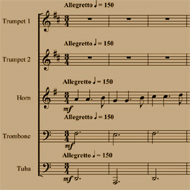 If you really think your brass quintet is that professional, good and disciplined, this is the ultimate piece you would love to play as the tour de force of capabilities!
 David wrote about Modal Madness in October 2012:
Brass Quintet in various modes based on the La Folia (madness) theme, ranging through the Dorian, Octatonic, Superlocrian, Neapolitan Minor and even an invented mode specially created for the horn player, who, in the theatrical version is evidently most affected by the modal changes.
This recording involves an electronic preview of the brass parts and the glissandi are not reproduced but the vocal parts are performed by the composer.
I look forward to a fully live production.
A full performance including text-elements and sheet music
|
- Solomons, David W.
- Uploaded to YouTube by the composer October 1, 2012
- Title: Modal Madness (being variations on La Folia) for brass quintet, in which the players occasionally sing and make appropriate comments
- Duration: 5'15"
- Recording date: September 2012
- The score and parts of plain version without singing and theatricals is available for brass quintets who are not into the theatrical sort of thing at http://dwsolo.musicaneo.com/sheetmusic/sm-171650_modal_madness_for_brass_quintet.html
Original manuscript in Biblioteque Nationale Paris.
First published by Heugel, Paris between 1810 and 1823.
The minuet has no musical connection whatsoever with the Folia-theme. There is even some debate going on till the present day if Sor intended to connect the Folies d'Espagne with the menuet.
|
Bergmann Edition |
|
5 pages in pdf-format (including menuet) with fingersetting
of theme and first variation |
|
Duration: 3'53", 08 kB (including menuet), sequenced
by M. Knezevic |
| Opening of Les folies d'Espagne et un menuet |
|---|
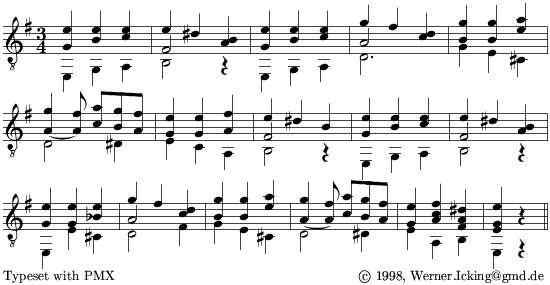 |
- Attademo, Luigi 'Folías; Sanz, Giuliani, Ponce, Gilardino, Sor,
Ohana'
- Title: Les Folies d'Espagne Variées e un Minuet op. 15a
- Duration: 1.re Variation 0'27", 2.me Variation 1'00", 3.me Variation 0'29", 4.me Variation 0'45", Menuet: Andante 2'00"
- Recording date: March 25 and 29 2001 at Quality Audio, Vercelli, Italy
- You can listen to the first variation in MP3 (542 kb) at the website of Luigi Attademo http://www.luigiattademo.it/
- Guitar by Carlo Raspagni, 1996
- See also the page Recommended Folia-recordings
- Bote & Bock Verlag
- Title: Las Folias de Espana
- Published by Bote amp; Bock, distributed by Schott Music Distribution, Mainz
- Publisher No. bb0923
- ISMN: M-2025-0923-4
- Brown, Elizabeth C.D. (19th century guitar) 'La Folía de España'
Elizabeth Brown wrote for the slipcase:
Thanks to the efforts of several very successful guitarists who also composed, the guitar enjoyed a resurgence in popularity in the early 19th century. The Spaniard Fernando Sor was such a guitarist, and was also one of the better composers. Although Sor actively performed and was considered a virtuosic guitarist, he also devoted himself to composition, producing several successful operas, ballets, symphonies and various chamber pieces in addition to his works for guitar. Perhaps as a result, his guitar compositions are in a sophisticated style that goes beyond merely showcasing the instrument's idiomatic capabilities. Published in Paris in the early 1820's, Sor's version of the folía exhibits a classical approach to the theme and variation form, with each variation serving as its own entity, often sharply contrasting in mood from the others. Since folías are always in a minor key, Sor is unable to include a major variation as further contrast, a common practice of the time. This may be why he chose to end the composition with this charming Menuet in the parallel major.
- Title: Les Folies d'Espagne, Variees, et un Menuet
- Released 2005 by Rosewood Recordings compact disc ROSE 1007-CD
- Duration: 4'27"
- Recording date: Fall 2004, at Queen Anne Christian Church, Seattle, Washington, USA
- Caceres, Oscar (guitar)
- Les folies d'Espagne op. 15 a
- Released 1990 by Adda compact disc 581214/17
- Casseus, Frantz editor of 'World's favorite selected masterpieces for
the classic guitar'
- Title: Las Folias de Espana
- Published 1970 by Ashley Publications Inc.
- p. 108-110 (3 p.)
- Clifford Essex Music
- Published by Clifford Essex Music Co. 195? or 196? London, as part of The Clifford Essex classic series of Spanish guitar solos by the world-famous masters and popular composers.
- Score 2 p., 30 cm
- Publisher No. 618 Clifford. Cover has label with imprint Mills Music.
- Fetherolf, Robert (guitar) 'Classical Guitar Recital'
- Title: Variations On La Folia and Minuet
- Released 2001 by Full Sail Music 634479725210
- Duration: 4'58"
- Recording date: unknown
- Jappelli, Nicolia (Romantic guitar) 'Fernando Sor, Pièces de
Sociétè'
- Title: Les Folies d'Espagne variees, Op. 15/a
- Released 2002 by Frame compact disc FR0242-2
- Duration: 3'18"
- Recording date: January 2002 in San Angiolo Vico l'Abate
- Guitar by Bernhard Kresse after a 'Stauffer' Legnani model
- Jeffery, Brian editor of 'Fernando Sor, complete works for guitar' in
a facsimile edition
- Title: Les Folies d'Espagne, variees, et un menuet ... Oeuvre 15
- Published 1977 by Shattinger International music corporation
- Volume 1, p. 134-136 (3 p.)
- Karstens, Thomas (guitar) 'Pasión Española'
- Title: les Folies d`Espagne variées op. 15 (from tecla edition edited by Brian Jeffrey)
- Released 1995 by Abadone compact disc abcd 93206, distributor Audio Electronic G.m.b.H.,P.O.B. 101338, D-40004 Düsseldorf, Germany (optionally the cd can be ordered at: Karstens@uni.koeln.de)
- Duration: 3'51"
- Recording date: August 1995 at Castle of Morsbroich, Leverkusen, Germany
- Martinez, Kurt (guitar) 'Folías'
- Title: Les Folies d'Espagne
- Released without indication of year (but it is 2003) by martinezkurt@cs.com without order number
- Duration: 4'48"
- Recording date: not mentioned in the slipcase
- See also the page Recommended Folia-recordings
- Papas, Sophocles T. revised and figured the manuscript
- Published by Columbia Music Co.
- Score 3 p., 31 cm
- Scheit, Karl revision and editor of fingering theme, 4 variations and
menuet for guitar solo
- Published by Universal Edition c.1983 Wien
- Score 5 p., 31 cm (also 8 p., 23,2 x 30,5 cm)
- Publisher No. 16709
- ISMN: M-008-00615-9
- Segovia, Andres (guitar) '1950s American recordings volume 2'
- Title: Variations sur les Folies d'Espagne & Menuet, op. 15a : Menuet en mi majeur
- Released 2007 by Naxos Historical series ADD compact disc 8111090
- Duration: 1'46"
- Recording date: 1952, 1954 and 1955 in New York for the Decca label
- Segovia, Andres (guitar) 'Nocturno'
- Title:Folías de España
- Released by Intercord (Germany) LP LC-1109
- Duration: 3'48"
- Segovia, Andres (guitar) 'My favorite Spanish encores'
- Released 1973 by RCA Red Seal New York LP ARL1-0485
- Duration: 3'48"
- Segovia, Andres (guitar)
- Title: Folias de Espana Op. 15 A
- Released by Intercord Int. 160815
- Recording date: May 1973
- Simov, Simeon (guitar) 'The Spanish Guitar - Fernando Sor'
- Released October 1, 1996 by Laserlight compact disc 14298
Album Notes: This disc is also available as a part of Laserlight 15-929.
- Released October 1, 1996 by Laserlight compact disc 14298
- Smith Brindle, Reginald revised and edited the manuscript
- Published by Schott c.1982, New York
- Score 6 p., 30 cm
- Publisher No. Edition 11448 for guitar solo
- ISMN: M-2201-1041-2
- Teicholz, Marc (guitar) 'Guitar Collection, Sor'
- Released 1996 by Naxos compact disc 8.553354, re-released June 2005 by Naxos compact disc 8.553722
- Duration: 2'47" (excluded the menuet) variations not indexed at all
- Recording date: February 21/26, 1995 at St. John's Church, Newmarket (Canada)
- Walkerova, Luise (guitar) 'Luise Walkerova - Leo Witoszynskyj, Kytarovy Recital'
- Title: Las folias de España
- Released 1971 by Supraphon 2 LP-set 1871/2
- Duration: unknown
- Recording date: May 29 - June 2, 1971, Studio Domovina, Prague
- Weiser, Aurelia (guitar) 'Fernando Sor (1778-1839)'
Duration: 1'19", 1.6 MB. (160KB/s, 44100 Hz)
The opening of Folie d'Espagne op. 15
© 2008 Aurelia Weiser, used with permission- Title: Folie d'Espagne op.15
- Released 2008 by Aurelia Weiser compact disc LC 18340
- Duration: 3'52"
- Recording date: September 6, 2007 in the Kammermusiksaal of the Hochschule für Musik Würzburg, Germany (Tonmeister Jürgen Rummel).
- More about Aurelia Weiser (and how to order the cd) at her website http://www.aureliaweiser.de/
- Yamashita, Kazuhito (guitar) 'F.Sor Complete Works for Guitar (16CDs),
Vol 1'
- Title: Les folies d'Espagne op. 15 a
- Released 1988 by Victor as compact disc VDC 14-16
- Duration: 4'39" (included the menuet)
- Recording date: December 1987 Kitakata Plaza Main Hall, Japan
Oeps, I did it again by Britney Spears |
The second part of the Folia chord progression is fully exposed in the refrain although the meter is 2/4 instead of the 3/4 Folia-theme. However many variations on the Folia-theme are written in 2/4 meter so no excuses to leave this tune out.
- Spears, Britney
- Released April 2000 as a single and as compact disc track
- Duration: c. 3'30" vocal version and 3'29" instrumental version
- Recording date: unknown
Subtitle/Note: Variation of theme by Marin Marais from Pièces de Viole (1681)
Colin Spiers wrote about his composition in an e-mail 19 August 2016:
The piece of mine you mention is a relatively early work that I wrote to develop composition technique through writing variations (a very useful way of doing this, because it enables the composer to work on thematic, structural and textural transformation processes in particular). The reason I chose the La Folia theme is because I like the simplicity and beauty of the harmonic progression. I used Marais's version because it is less familiar to pianist's than, say, Rachmaninov's so-called 'Corelli' variations. I had also performed excerpts from the Marais version with a gamba player and produced my own realisation of the figured bass, a process that set me off on the path of the original composition.
I should finally mention that I am unhappy with this piece, but may one day find the time to reduce its duration so that the best variations only are kept.
- Spiers, Colin
- Theme and 40 variations,
- Dedication note: Michael Dudman in memoriam
- Published 1981, difficulty: advanced
- Duration: c. 35 minutes
-
A preview of the first 20 variations is available on the AMC site; the direct link is: http://awscdn.australianmusiccentre.com.au/documents/ds_7886_10121.pdf
-
The score is available from the Australian Music Centre: Variations on La Folia : for piano solo by Colin Spiers : Work : Australian Music Centre
- Sprung, Arnd
- Duration: c. 12'30"
La Folia, 7 variations for violoncello solo |
|
The sheet music |
- Stahel, Michal (baroque cello)
- Released 2012 by Pavlík records compact disc without ordernumber
- Duration: 5'06"
- Recording date: October 1-6, 2012 in the Concert hall of the Imrich Csáky Castle in Veľký Biel, Slovakia
- More about the composer at http://www.michalstahel.com/
The composition is a passacaglia over two 'grounds': La Folia and the gregorian Dies irae at the same time.
- Stegemann, Michael
- First played: Nov. 19, 1997 in the Gedächtniskirche in Berlin by Wolfgang Zoubeck (a wellknown german organ-player and composer)
- Duration: c. 9'00"
- Étrennes contenant les danses favorites de la troupe de Ravel: cahier 1, arrangé pour piano par l'éditeur. Includes 27 dances
- Published 180? by H.C. Steup, Amsterdam, The Netherlands
- 5 volumes, 25 cm
- Collection dr. D.F. Scheurleer (Inv. 3826)
- Part of the collection of the Royal Library in Den Hague, The Netherlands NMI 21 F 11
Andrew Stiller wrote about his composition:
My piece was inspired by Marin Marais' wonderful set of folia variations for gamba, but is not based on or imitative of it. The title is a deliberately over-literal translation of the French 'les folies d'espagne', which I used both in homage to Marais and in recognition of this being a guitar piece. It is a 'folly', too, because for most of its length it treats the theme 'foolishly'--not as a ground bass but as a simple sequence of notes (G D G F Bb F G D) that has 'adventures': very fast repetitions in the minimalist fashion, for example; transpositions, distortions, various kinds of contrapuntal manipulation. The guitars are required to use scordatura, so that the range goes down to a low D, and quarter-tones are available. In places, the music modulates into tonalities with quarter-tone tonics, in other places the quarter-tones are used to imitate the upper partials of drums: there is a quote from Ravel's Bolero, and a spoken line from Windsor McKay's Dreams of the Rarebit Fiend. A long rock-'n-roll passage leads to a climax invoking the great lute tradition of the 16th-17th century, in the middle of which a simultaneous cross-relation (Fis against F) finally forces the theme to acknowledge its tonal roots and produce the traditional cadence that had hitherto been missing. Following this resolution the last five bars are repeated, then the last four, the last three, the last two, the last...
More about the oeuvre of Andrew Stiller, the founder of Kallisti Music Press at: http://www.kallistimusic.com/Stiller.html- Castellani-Andriaccio Duo (guitar)
- First performed (2 guitars): February 14, 1992 at the Smithsonian Institution
- Duration: c. 14'00"
- Yet to be recorded, the four guitar version remains unperformed
- Stiller, Andrew
- Published 1981 (two guitar version) and 1984 (four guitar version) by Kallisti Music Press, Philadelphia
- 25 pages (two guitar version) in two parts
- 30 pages (four guitar version) in four parts
- Spielbuch für Gitarre, Heft II 3752 (28 pages in total)
- Published 1939 Edition Schott s.s.s.35998
- 4 pages: number 22, 23, 24, 25, size 28x19cm (landscape)
A Folia from Norway for solo voice. The meaning of the text is unknown (no translation from the Norwegian language)
- Løvlid, Unni (voice solo)
Norwegian Folia for solo voice Unknown source 
- Published at YouTube: https://www.youtube.com/watch?v=UFkv_gqA_8E
- Publishedat YouTube by the Goethe-Institut Norwegen April 18, 2018
- Sheet music unknown source
- Strauß, Marlo (1957- )
- La Follia per Mandolino solo, theme and 10 variations (1991)
Marlo Strauß wrote about La Follia per Mandolino solo:One day I had to write and play a continuo for Corelli´s Follia-variations. To study and really understand the whole thing I wrote these variations first to make sure that I really know the theme and its character.
Duration: 1'38", 481 kB.( 40kB/s, 22KHz)
Theme as indicated in the sheet music and variation 9 as played by Leoniek Hermans
© Marlo Strauß/Leoniek Hermans, used with permissionTheme of La Follia per mandolino solo © Grenzland Verlag, used with permission 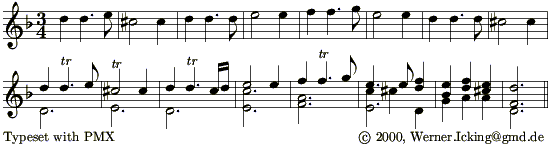
- Hermans, Leoniek (mandolin) 'Schmetterlinge'
- Released 1997 by Grenzland Verlag Theo Hüsgen Aachen, GVH KM - 2009
- More about the oeuvre of the composer at http://marlostrauss.kulturserver-nrw.de/
- Published by Grenzland Verlag compact disc AM 005
- Duration:
 Thema - Adagio 0'49"
Variation 1 0'46"
Variation 2 - Allegro 0'25"
Variation 3 0'27"
Variation 4 - Vivace 0'23"
Variation 5 0'18"
Variation 6 - Poco allegro 0'29"
Variation 7 - Allegro 0'33"
Variation 8 - (nur auf der a'-Saite zu spielen) 0.25"
Variation 9 - Adagio 0'52"
Variation 10 - Allegro 0'38"
Thema - Adagio 0'49"
- Recorded 1994-1996 in Studio A, Stein
- Stubbs, Stephen (? - )
- Improvisation I on the Folia bass (2004)
Most Folia variations are played to show off the virtuosic capabilities of the performers. These variations are mainly designed to impress the listener and are not intended as an organic unity. The improvisations of Stubbs c.s. seem to have a different approach; to give an inner reflection of the music in a floating sober style.
- Stephen Stubbs (baroque guitar), Maxine Eilander (Spanish aand Italian harps),
Erin Headly (viola da gamba, lirone), Milos Valent (violin, viola) 'Teatro Lirico'
- Released February 2006 by ECM New Series 1893 4763101
- Duration: 7'45"
- Recording date; February 2004 in Propstei St. Gerold
- See also the page Recommended Folia-recordings
- Improvisation II on the Folia bass (2004)
- Stephen Stubbs (baroque guitar), Maxine Eilander (Spanish aand Italian harps),
Erin Headly (viola da gamba, lirone), Milos Valent (violin, viola) 'Teatro Lirico'
- Released February 2006 by ECM New Series 1893 4763101
- Duration: 6'44"
- Recording date; February 2004 in Propstei St. Gerold
- See also the page Recommended Folia-recordings
- Svenblad, Ronnie (? - )
- Sinclairvisan (2001)
See for more detail about the tune Sinclairvisan Anonymous traditional
Ronnie Svenblad wrote about the tune:
I made a record with Swedish folk songs and Sinclairvisan is a well known folksong in Sweden. I think it is a great song. The first time I heard it was by Jan Johansson on the record "Jazz på svenska"
Duration: 4'28", 5.38 MB. (160KB/s, 44100 Hz)
The complete set of variations
© 2001 Ronnie Svenblad, used with permission- Svenblad, Ronnie (keyboard and computer-programs)
- Released on the website http://www.electromancer.com/showTrack.php?id=1108852955 (no longer available)
- Duration: 4'28"
- Recording date: 2001 in Sweden in the genre Ambient/New Age
- Svoboda, George (Jiri) (1954- )
- Folias (6 variations for two classical guitars)
In September 2000 George Svoboda wrote in an e-mail:Folia has always been a fascinating form to me. There is something eternal in those harmonies. I wrote that piece in 1994. It is not the greatest piece of music but we (Fred and I) had fun playing it!
Duration: 0'54", 03 kB
Theme as indicated below in the sheet music
Theme of Folias © G. Svoboda, used with permission 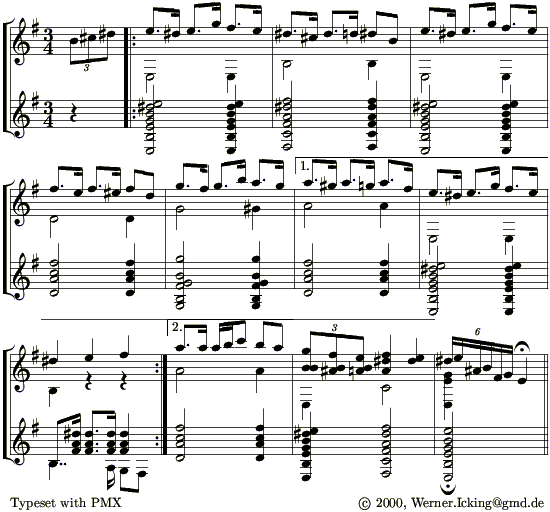
- Benedetti/Svoboda Duo (2 guitars) 'Scirocco - Desert Wind'
- Released 1994 by SBE Records compact disc SBECD002
- Duration: 4'55"
- Recording date: Summer 1994 at Gandharva Studios, San Diego, California US
- Swerts, Piet (1960- )
- La follia per violino solo (1990)
- Swerts, Piet
- Published by CeBeDeM (Aarlenstr.75-77 1 verd. 1040 Brussel + 32 2 94 230 94) c.1992, Brussels
- Eight variations
- Score 8 leaves of music, 31 cm
- Duration c. 8'00"
- Sychra, Andrei (1773-1850)
- Les folies d'espagnes (c.1825) theme and 3 variations for semistrunnaia gitara
S. Walsh wrote about this piece in an e-mail March 2004:
There is a Folia-version for semistrunnaia gitara - a Russian seven-string guitar tuned DGBDGBD - by A. Sychra (1773-1850). He was the founding father of the Russian guitar and wrote hundreds of pieces. He taught the instrument and some of his pupils became composers too.
This particular piece is in 'Journal de Petersbourg' no. 33 and consists of the theme and 3 variations in E minor. Most of the title page is in Russian but it clearly states ' Journal de Petersbourg pour la guitare par A. Sychra'. The collection has 144 pieces in all. I think they were published in instalments. A lot of the pieces are very attractive but this setting of La Folia seems a bit dull.
The edition that is in the Library of Congress has the dates 1828-29 pencilled in by a librarian. But Oleg Timofeyev's liner notes to his cd 'The golden Age of the Russian Guitar' (Dorian Recordings) dates the start of this collection of pieces starting in 1818. I doubt if Oleg Timofeyev has ever recorded this particular piece which is not Sychra at his best.- Journal de Petersbourg
- Edition available in the Library of Congress
- Duration c. 1'50"
Composers letter: Anonymous, A, B, C, D, E, F, G, H, I, J, K, L, M, N, O, P, Q, R, S, T, U, V, W, Y, Z You're missing one or more?
.
Please e-mail your contribution to
folia@chello.nl
and it will be added to the inventory
best viewed at 800 x 600